

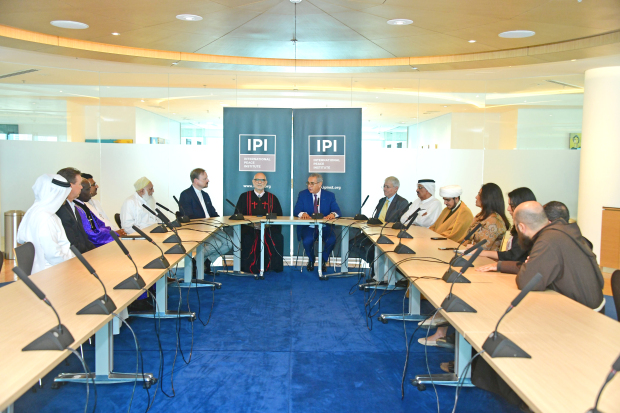
AN initiative should be launched in schools to ensure that youngsters are not exposed to any hate narratives or violent extremism, according to a number of religious leaders.
They were speaking at a roundtable conference on ‘Interfaith Solidarity and Global Challenges to Peace’ at the International Peace Institute, Middle East and North Africa (IPI Mena) office in Bahrain Financial Harbour’s Harbour House.
The discussion was held in partnership with National Evangelical Church (NEC) pastor of Arabic language congregation and Al Bayareq Bayda Society founder and chairman Reverend Hani Aziz.
“I was strongly encouraged at the many different faiths represented at the gathering – Baha’i, Christian, Hindu, Jewish, Muslim, among others,” said IPI Mena Bahrain senior director Nejib Friji.
“It was representative of what is needed in a multilateral system: unity, solidarity, empathy, tolerance, and open dialogue.
“All have agreed to look into creating and launching an educational advisory initiative that can help schools be clear of any content that would instigate or refer to extremism or hatred – and that applies to all levels of education from kindergarten to primary, high school and university.
“We know that Bahrain has done a great job in this regard, and we would like to be inspired by this experience to help the religious leaders and others to reach the required level of education programmes that would form global citizens as well as national citizens.”
Rev Hani stressed the importance of understanding the different cultures and religions that live together while the Very Reverend Dr Richard Fermer, the new Dean of St Christopher’s Anglican Cathedral in Manama, underlined that peace from Judeo-Christian traditions speaks of wholeness and unity.
“Moving towards that unity, we must see the similarities between religions, but also recognise the differences and that is how we move into dialogue,” he said.
Representative of the Jewish community and president of the Association of Gulf Jewish Communities Ebrahim Nonoo said that dialogue should start with education and children.
“Children must ask the questions that are burning inside them, and we have a responsibility to answer them from a religious perspective – this is how you create understanding and build empathy towards tolerance,” he said.
He also pointed to the role that IPI and think tanks can play in creating a safe space for interfaith understanding through youth and voiced his strong support for such an initiative.
Bohra community representative Zakiuddin Abbas said that education does not only remain in the schools and academic spheres but in the home as well.
Also attending the forum were Law Courts director at the Justice and Islamic Affairs Ministry Dr Abdulla Al Maqabi (representing the Shia community), NEC Urdu language pastor Isaac Inayat and Bethel Church of Nations pastor Job Nelson (representing the African community).
King Hamad Global Centre for Peaceful Coexistence trustee and representative of the Baha’is, Shahnaz Jaberi, St Christopher’s Cathedral lay chair David Axtell and co-ordinator of the office of relations of the Baha’is of Bahrain Jalal Khalil also attended.
mai@gdnmedia.bh
&uuid=(email))