

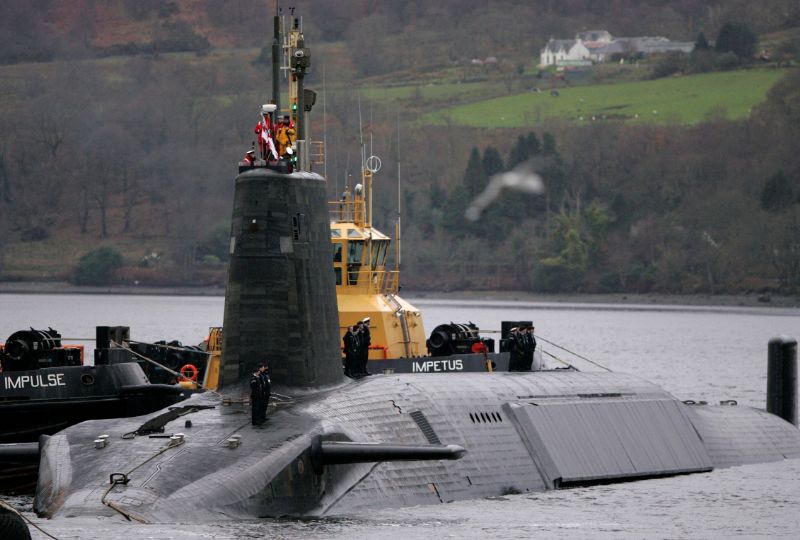
Britain’s Trident nuclear-deterrent system misfired during a test last month, sending a missile crashing into the ocean off the Florida coast near the submarine that launched it, The Sun newspaper reported yesterday.
The Ministry of Defence confirmed that an “anomaly” had occurred during the test but said Britain’s “nuclear deterrent remains safe, secure and effective”.
With Defence Secretary Grant Shapps on board the HMS Vanguard to witness the test, The Sun said, the first-stage boosters on the missile – equipped with dummy warheads – failed to ignite.
The result marked the second successive test failure of a Trident missile after one was reported to have veered off course in 2016, an embarrassing outcome for a country that once boasted the largest and most powerful naval force in the world.
“It left the submarine but it just went plop, right next to them,” The Sun quoted an unspecified source as saying.
In a statement, Shapps said that the missile test had been the culmination of a Demonstration and Shakedown Operation on Vanguard to gauge the performance of its weapons and its crew, after it returned from a lengthy refit.
He said the operation reaffirmed the effectiveness of the UK’s nuclear deterrent, that the submarine and crew were “successfully certified” to be ready for operation, but an anomaly occurred that was “event-specific”.
“There are no implications for the reliability of the wider Trident missile systems and stockpiles,” he said. “Nor are there any implications for our ability to fire our nuclear weapons, should the circumstances arise in which we need to do so.”
Shapps gave no further details, citing national security.
The government could face questions over the failure, and the fact that it was reported by the media, at a time of heightened international tensions when the readiness of Britain’s navy has been under scrutiny in the event it is drawn into a full-blown conflict.
Earlier this month, one of Britain’s two flagship aircraft carriers, the HMS Queen Elizabeth, had to be withdrawn from the largest Nato exercise since the Cold War over a propeller issue.
Matthew Savill, director of Military Sciences at the Royal United Services Institute, a defence and security think tank, said nuclear powers watch each others’ tests.
&uuid=(email))