

Gulf countries, including Bahrain, could face risks related to inflation, cybersecurity, unemployment and economic downturn, according to the Global Risks Report released by the Geneva-based World Economic Forum (WEF) yesterday.
The 20th edition of the flagship publication on global risks was produced by Global Risks Initiative at the WEF’s Centre for the New Economy and Society.
The report draws on the views of more than 900 global leaders in business, government, academia and civil society surveyed in September and October 2024.
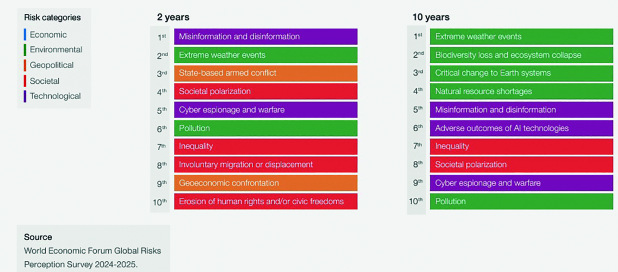
Global risks ranked by severity over a two-year and 10-year period
It identifies and analyses the most pressing risks across immediate, short- and long-term horizons, aiming to equip leaders with foresight to address emerging challenges.
The report lists 34 risks that were incorporated into the WEF’s 2024 Executive Opinion Survey which was administered between April and August 2024 and covered more than 11,000 business leaders in 121 economies who identified the top five severe threats to each country over the next two years.
Five GCC countries are mentioned in the report, with no data on Kuwait.
The top five risks that Bahrain is likely to face are: Economic downturn (for example, recession or stagnation); inflation; labour and/or talent shortage; unemployment, or lack of economic opportunity, and cyber insecurity.
Inflation, economic downturn, public debt, labour shortage and unemployment were among the five risks identified for Bahrain in the 2024 edition of the same report.
Risks cited for other GCC countries are:
UAE – inflation; asset bubble burst; extreme weather events (floods, heatwaves, etc); cyber insecurity and economic downturn.
Saudi Arabia – asset bubble burst; inflation; adverse outcomes of artificial intelligence technologies; armed conflict (interstate, intrastate, proxy wars, etc) and economic downturn.
Oman – extreme weather events (floods, heatwaves, etc); economic downturn; unemployment or lack of economic opportunity; adverse outcomes of artificial intelligence technologies and inflation.
Qatar – inflation; economic downturn; asset bubble burst; attacks on critical infrastructure and geo-economic confrontation (sanctions, tariffs, investment screening, etc).
State-based armed conflict has been identified as the most pressing immediate global risk for 2025, with nearly one-quarter of respondents ranking it as their most severe concern for the year ahead.
Misinformation and disinformation remain top short-term risk for the second consecutive year, underlining their persistent threat to societal cohesion and governance by eroding trust and exacerbating divisions within and between nations.
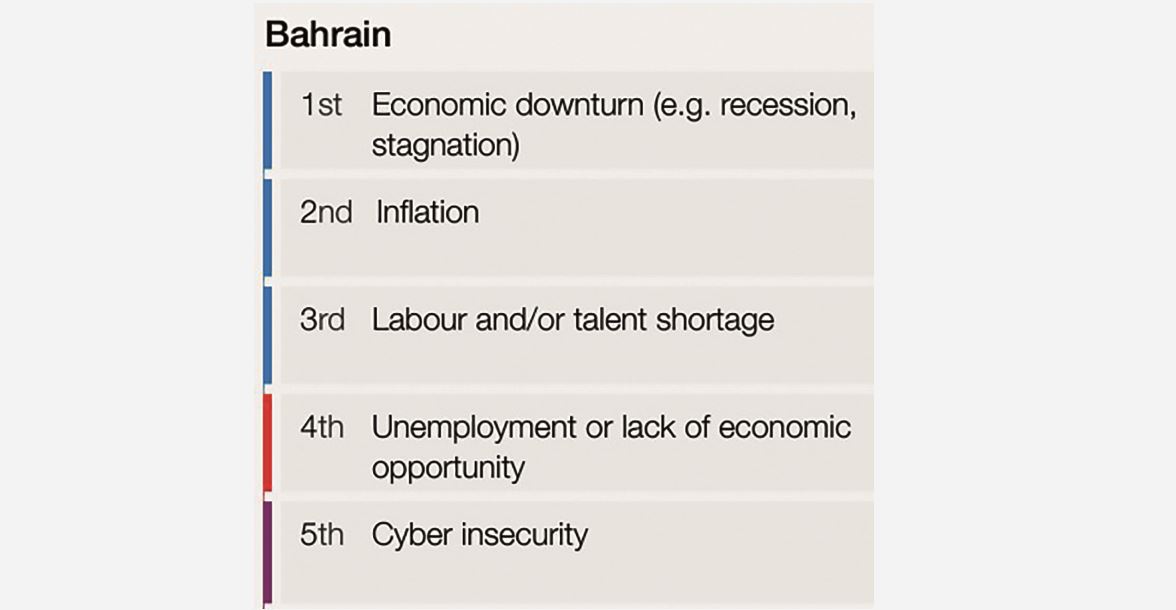
The top five risks Bahrain could face listed in the 2025 edition of the WEF report released yesterday
Other leading short-term risks include extreme weather events, societal polarisation, cyber espionage and warfare.
“The risk of further destabilising consequences following Russia’s invasion of Ukraine, as well as in the Middle East and in Sudan are likely to be amplifying respondents’ concerns beyond 2025 as well,” states the report.
“Rising geopolitical tensions and a fracturing of trust are driving the global risk landscape” said WEF managing director Mirek Dušek.
“In this complex and dynamic context, leaders have a choice: To find ways to foster collaboration and resilience, or face compounding vulnerabilities.”
Environmental risks dominate the longer-term outlook, with extreme weather events, biodiversity loss and ecosystem collapse, critical change to Earth systems and natural resources shortages leading the 10-year risk rankings.
Nearly two-thirds of respondents anticipate a turbulent or stormy global landscape by 2035, driven in particular by intensifying environmental, technological and societal challenges.
sandy@gdnmedia.bh
&uuid=(email))