

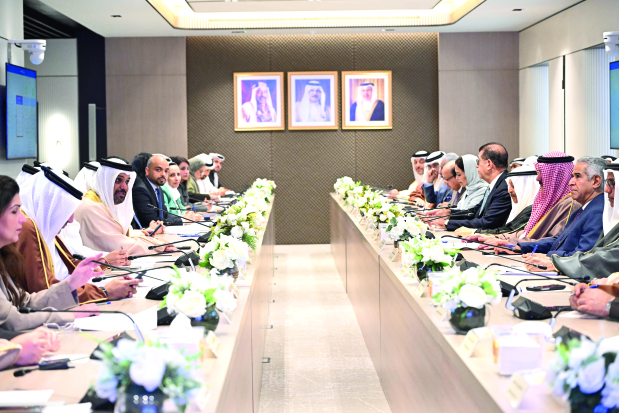
The legislative and executive authorities held a joint meeting yesterday to continue consultations on the state’s budget 2025-2026.
It was co-chaired by Finance and National Economy Minister Shaikh Salman bin Khalifa Al Khalifa, Parliament Speaker Ahmed Al Musallam and Shura Council Chairman Ali Saleh Al Saleh.
The meeting was attended by ministers, deputy chairmen of Shura Council and Parliament, chairmen and members of the Financial and Economic Affairs Committees of both chambers, and officials.
Improving the Bahraini families’ living standard, providing promising job opportunities, achieving sustainable national economic growth, and implementing economic and financial programmes are key pillars of joint co-operation between the legislative and executive authorities, Mr Al Musallam affirmed.
He said consultative meetings will continue next week.
Mr Al Saleh described the royal directives as a roadmap in discussing the state’s general budget, affirming keenness on implementing them. The minister said the current phase requires both sides to double efforts and work together to advance co-operation and joint work.
“The aim is to build on previous initiatives and projects to drive economic growth and create promising opportunities for citizens,” Shaikh Salman said, stressing the need to take into consideration financial sustainability while discussing the state’s budget draft law.
In this context, several proposed initiatives were reviewed to achieve financial sustainability following the completion of the fiscal balance programme by reaching a primary surplus in the state’s budget through expenditure reductions and increased non-oil revenues.
Discussions also focused on providing financial support directly to citizens while maintaining price stability for essential goods and services.
Additionally, petrol prices will be adjusted according to international rates, with cash support provided to eligible citizens through the “Citizen Account.” The price of natural gas will also be revised to encourage energy efficiency in factories and enterprises.
Furthermore, an investment of BD400 million will be allocated over the next two years for electricity and water distribution projects. A new cash subsidy for electricity and water will be introduced for first-time homeowners through the “Citizen Account.”
To achieve net-zero carbon emissions, a carbon pricing mechanism will be introduced, imposing a fixed charge for emissions exceeding a specified annual threshold.
To diversify revenue sources while maintaining a competitive business environment and supporting private sector growth, legislative measures will be introduced to expand corporate income sources to include a specific category of companies based on their annual revenues and profits.
To safeguard national employment, exemptions will be granted to key sectors that impact the local workforce, along with incentives to increase the employment of Bahraini citizens.
Lastly, an overview of value-added tax (VAT) revenues was presented, showing that institutions, residents and visitors contributed 92 per cent of VAT collections in 2024, while Bahraini citizens from middle and low-income groups contributed only 2pc. This was due to the exemption of 94 essential goods and 1,300 government services from VAT.
&uuid=(email))