

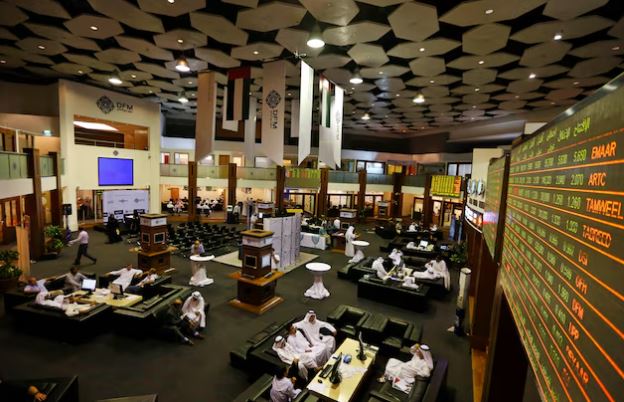
GULF equities fell yesterday, tracking a global selloff from conflict in the Middle East after the UAE said drones had targeted an area near its Barakah nuclear power plant and Saudi Arabia said it had intercepted three drones.
In Dubai, the main share index fell for a seventh straight session, its longest losing streak in more than two years, and closed 1.7 per cent lower. Losses were led by real estate, industrial and consumer discretionary stocks.
Blue-chip developer Emaar Properties dropped 3.6pc, Dubai’s largest lender Emirates NBD lost 1.7pc, and budget carrier Air Arabia declined 3.3pc.
In Abu Dhabi, the index dropped 1.2pc, with all sectors ending in negative territory, led by technology, utilities and real estate. Abu Dhabi Commercial Bank shed 4.9pc, while Aldar Properties lost 3pc
“Despite the short-term downside risks, the markets could continue to see long-term upside potential, with support from large investment initiatives such as plans from (Abu Dhabi state oil firm) Adnoc to increase production levels, as well as large-scale government initiatives such as the UAE-Oman corridors and crude pipeline capacity expansion,” said Milad Azar, market analyst at XTB Mena.
The Qatari benchmark fell 1.1pc, weighed down by losses across all constituents. Qatar National Bank, the region’s largest lender, slipped 1pc, while Industries Qatar slid 1.3pc. Saudi Arabia’s benchmark eased 0.1pc, extending losses to a fifth straight session, pressured by industrial, consumer staples and materials stocks. Saudi Arabian Mining Company fell 1.5pc, and Riyad Bank slipped 1.2pc. Saudi Chemical Holding gained 4.2pc after announcing a military materials supply agreement with the National Company for Mechanical Systems.
Outside the Gulf, Egypt’s blue-chip index declined 0.7pc, with Commercial International Bank down 1.1pc and Fawry for Banking Technology losing 2pc.
&uuid=(email))