

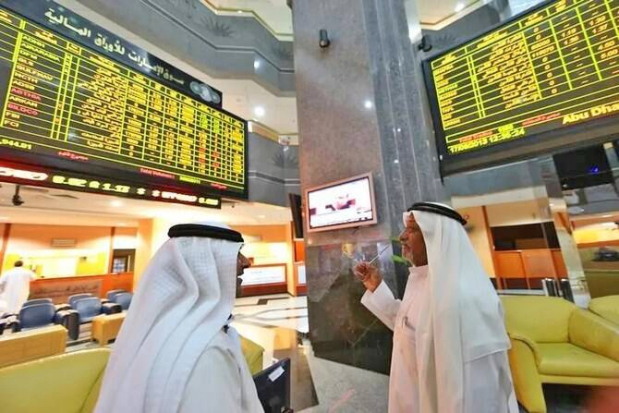
Gulf bourses experienced a downturn yesterday as fresh US tariffs dampened investor confidence across the region, leading to widespread sell-offs in line with last week’s global market slump.
Saudi Arabia’s benchmark Tadawul All Share Index experienced a significant drop of 6.78 per cent during yesterday’s trading session, losing 805.46 points to close at 11,077.19. This marks its steepest single-day decline in months. The total trading volume for the index reached 8.43 billion riyals ($2.24bn), with only one stock advancing and 252 retreating.
The MSCI Tadawul Index also saw a decline, falling by 98.60 points, or 6.56pc to settle at 1,405.55.
Meanwhile, the kingdom’s parallel market, Nomu, dropped by 1,992.71 points, or 6.5pc, closing at 28,648.22. Notably, 89 listed stocks advanced in Nomu, while 11 retreated.
The worst performer of the day on the main market was Methanol Chemicals, whose share price fell by 10pc to 12.06 riyals, while the only positive performer stock was Nama Chemicals with its share price surging by 0.5 pc to 30.45 riyals.
In an interview with Arab News, Gaby Tchennozian, chief investment officer at a Dubai-based family office, highlighted that global market turbulence – triggered by an escalating US-led trade war – has not spared the Gulf region.
“Even though the region isn’t directly involved in the trade tensions, the spillover is already being felt in markets,” he said.
Qatar’s QE Index declined by 4.23pc, while Kuwait’s Premier Market Index dropped 5.69pc. Other regional markets were similarly affected, with Muscat’s MSX 30 Index falling by 2.62pc and the Bahrain All Share Index down by 1pc. Investors are closely monitoring the impact of escalating trade tensions and the recent decline in oil prices.
This followed the announcement by US President Donald Trump of a 10pc reciprocal tariff on Gulf imports.
Although UAE markets were closed yesterday, the Abu Dhabi Securities Exchange ended the previous week with a 1.9pc loss on Friday. Similarly, Dubai’s DFM General Index closed 1.5pc lower on April 4, indicating that further declines could occur when trading resumes today.
“For investors, the lesson isn’t just about reacting to headlines. It’s about building portfolios that can weather unexpected shocks,” Tchennozian noted.
In Egypt, trading was temporarily halted in several stocks yesterday for 10 minutes after having dropped by 5 and 10pc, in line with market regulations designed to prevent excessive volatility.
Tchennozian anticipates that market turbulence will persist for the next 2-3 months due to continued uncertainty.
While Opec’s production increase was overshadowed by news of US tariffs, oil prices remain near GCC break-even levels. However, they could decline further if global trade weakens.
Potential rate cuts by the Federal Reserve may provide some relief, but tensions in the Red Sea are dampening market sentiment.
Tchennozian cautioned that if trade wars escalate or regional conflicts intensify, this volatility could extend well into late 2025.
The White House confirmed on April 2 that a 10pc tariff on GCC imports was imposed to address what Trump described as “long-standing unfair trade practices.”
Although the Gulf states were spared from more severe penalties – 41pc for Syria and 39pc for Iraq – the move has raised concerns about rising import costs for US-sourced goods, particularly in sectors like construction and electronics.
“These tariffs will remain in effect until such a time as Trump determines that the threat posed by the trade deficit and underlying non-reciprocal treatment is satisfied, resolved, or mitigated,” the White House said in a statement on April 2.
Gulf banking stocks were hit hardest amid growing fears of a potential US economic slowdown. The sell-off mirrored the steep losses seen on Wall Street on April 4.
For the GCC, the White House’s exemption is significant, as oil and gas constitute more than 60pc of Saudi Arabia’s exports to the US and remain a vital part of Gulf-US trade relations.
Oil prices plunged 7pc on Friday, hitting a three-year low, after China retaliated in the escalating trade war by imposing 34pc tariffs on all American goods, effective April 10.
Tchennozian further emphasised that Gulf markets are bearing the pressure as global indices continue to slump due to the ongoing US-led trade war. “GCC governments must act swiftly and decisively to reassure investors and safeguard their economies,” he said.
He suggested that this could be achieved by ramping up infrastructure spending while central banks ensure liquidity, particularly for small and medium enterprises.
“Above all, clear and consistent communication from policymakers is key to reassuring investors that the region is not just weathering the storm – but actively steering through it,” he added.
&uuid=(email))