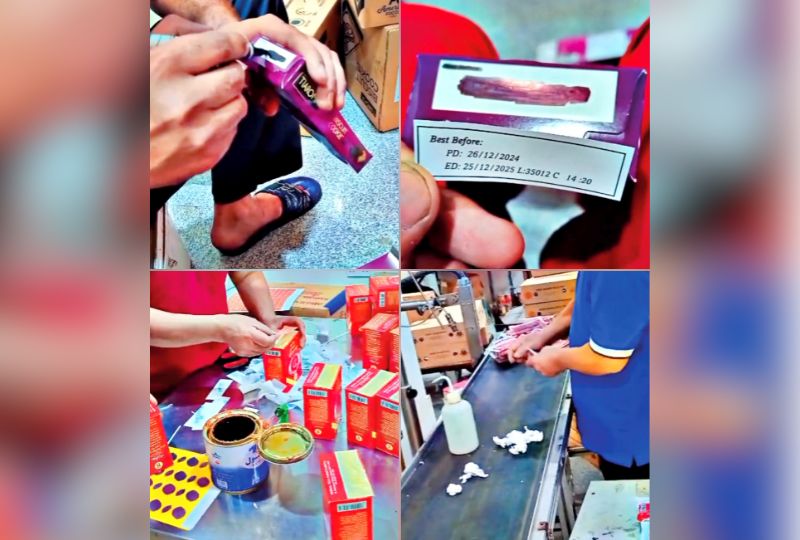
The Lower Criminal Court continues to hear the case of 22 administrators and employees of a family business that has been accused of putting expired food products on sale after altering the validity dates on the packaging.
Alongside the defendants, two food distribution companies are also standing trial as an ‘artificial person’.
The hearing has been adjourned to July 22 for the Public Prosecution to respond to defence arguments while the suspects continue to be remanded into custody.
Lawyer Rabab Al Arrayed, representing the owner and the two businesses, stated in a defence memo that her client had no direct role to play in any supposed fraud scheme, as he had greater matters to attend to in the company.
“The administrators had no actual part in running the warehouses, and my client was not directly in charge of the locations where the allegedly expired products were found,” she told the judge.
“His role as the director of the company was to cut deals and sign contracts, while others were tasked with running the warehouses and selling the products.
“By law, the responsibility for an act falls on the individual directly involved in it, which does not apply to a board chairman or company director who are separated from the act.
“Moreover, the law does not criminalise the mere act of possessing and storing expired goods, it only becomes a crime when these goods are put on sale or distributed.
“The spoiled goods were marked in company records as losses and were slated to be destroyed. They were never to be sold to the public, so there was no crime in the first place.
“As per the companies’ audit reports, this stock wasn’t recorded as part of inventory, but rather as a negative.
“The warehouse’s internal database, which is used to keep track of stock, has a feature to remove expired products and record them as losses, which proves that there was never any intention to trade in the goods illegally.”
Ms Al Arrayed further dismissed the accusation of practising a business without a licence, stating that both businesses have a permit to distribute food, and further dismissed claims that the company did not have a food handling permit.
She stated that the procedures carried out by judicial officers when the warehouses were searched did not follow the law, as samples of alleged spoilt food should have been sent for lab analysis, to determine whether or not they were harmful to humans and animals.
The GDN earlier reported that a worker who had recently arrived in Bahrain in order to work in one of the warehouses had lodged a complaint with the police about the alleged malpractice.
The Industry and Commerce Ministry took action, issuing an order to close the violating warehouse and affiliated outlets, which were all placed under judicial seizure.
Experts from the ministry were tasked with making an inventory of the stock and identifying expired items, as well as taking necessary measures to remove any expired goods from the market.
The inventory allegedly revealed more than 14,000 expired food products as well as tools that were used to erase original expiry dates.
First chief prosecutor and assistant attorney general Wael Buallay affirmed that the Public Prosecution was committed to protecting public health and preventing the waste of consumable goods.
Maintenance technicians have also been allowed periodic access to the warehouse to ensure proper refrigeration and prevent spoilage.
The GDN reported last month that the company was identified as Aldaaysi Markets and its registered warehouse, Aldaaysi Distribution.
Preliminary investigations indicated that spoiled food products, including biscuits and cookies, were allegedly marketed and sold after their expiry dates were altered or replaced.
Mr Buallay had said the decision to name the company was in the interest of public health and safety.
zainab@gdnmedia.bh