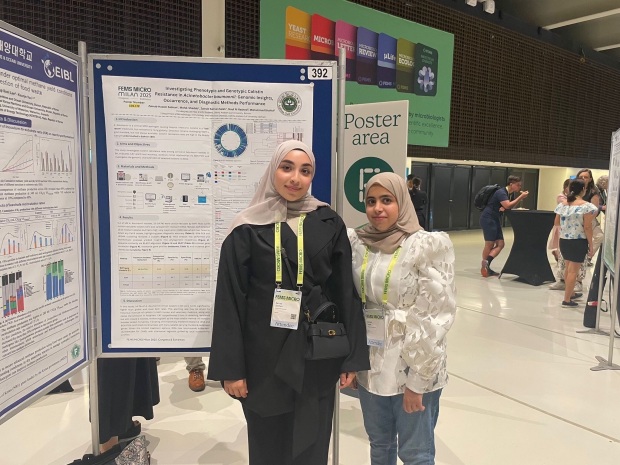
TWO Bahraini medical students presented their research on drug-resistant superbugs at an international conference in Italy.
Zainab Salman and Zainab Saleh, from the College of Medicine and Medical Sciences at the Arabian Gulf University (AGU), attended the Federation of European Microbiological Societies (FEMS) Conference in Milan.
Their research poster was titled ‘Phenotypic and Genotypic Colistin Resistance in Acinetobacter baumannii: Genomic Insights, Occurrence and Diagnostic Methods Performance’ and was supervised by AGU Microbiology, Immunology and Infectious Diseases head Professor Mohammed Shahid, and Dr Mohammed Shadab from the College of Medicine and Medical Sciences.
The research highlighted the growing threat of antimicrobial resistance, particularly in bacteria associated with hospital-acquired infections, with a focus on genomic understanding of the bacteria and assessing the effectiveness of current diagnostic methods.
Their participation in this prestigious international conference reflects AGU’s commitment to supporting student-led research and strengthening its presence in global academic forums, said a statement yesterday.
It also reinforces the university’s standing as a distinguished scientific centre in the region that contributes to finding innovative solutions to global health challenges.
Bahrain is taking pro-active efforts to fight off superbugs or anti-microbial resistance (AMR) to antibiotics.
The misuse and overuse of antimicrobials in humans, animals and plants are the main drivers in the development of drug-resistant pathogens.
The GDN reported last year that World Health Organisation’s strategic advisory group chairperson for AMR, Dr Jameela Al Salman, called on Bahrain’s population to moderate their use of antibiotics in the wake of a growing crisis.
She attributed the rise in AMR cases to the widespread and often unnecessary prescription of antibiotics by medical professionals, as well as in the farming sector.
The United Nations health agency had previously declared AMR to be one of the top 10 global threats to human health and said an estimated 1.3 million people die every year directly due to resistant pathogens.
Studies have revealed that using or misusing antibiotics, poor infection prevention and control practices, living or working in unclean conditions and mishandling food could increase the risk of spread of antimicrobial-resistant germs.
The World Bank estimates that AMR could result in $1 trillion additional healthcare costs by 2050, and $1 trillion to $3.4 trillion gross domestic product (GDP) losses per year by 2030.