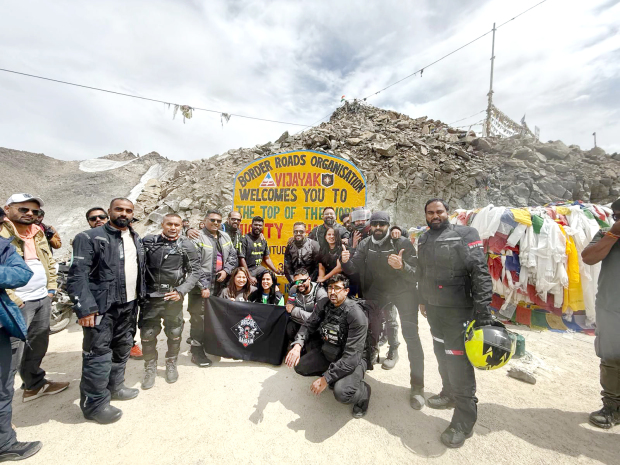
Eleven Bahrain-based motorcycle riders have successfully conquered Umling La Pass, the highest motorable road in the world and one of the toughest riding routes on the planet.
Standing at a staggering 19,024 feet in Ladakh, India, the mountain pass tests even the most seasoned riders with its thin air, freezing temperatures and unpredictable terrain.
The expatriate group’s achievement marks a significant milestone for the kingdom’s motorcycling community, showcasing both their passion for adventure and resilience.

Bahrain-born Anup Simon told the GDN that scaling the pass was a dream-come-true moment for the team, which comprises Indian expatriates – Romeo Biju, Amith Kumar, Jerin Davis, Anoop Kottarathil, Harri Zachary, Ancel Bernard, Anup Nair, Bijay Raj, Gishin Koshy and Prachood Pradeep ... all of whom are members of Brigade Motorcycling Club (MC) Bahrain.
It was after much thought that the riders – aged between 32 and 57 – decided to embark on the trip this month and booked flights to India.
They rented adventure bikes and adopted a cautious step-by-step approach to help their bodies adjust to the extreme climatic conditions.
“Planning the acclimatisation was one of the most important parts of the journey, and we made sure to take our time to the top,” Mr Simon told the GDN.
“We spent several days in Leh, gradually climbing to passes such as Khardung La and Pangong Tso, before attempting Umling La,” the 34-year-old added.
Leh is the main city and district headquarters of Ladakh and it is the gateway to many high altitude passes in the region, including Umling La. Riders or travellers attempting to scale Umling La usually start their journey from Leh, which lies about 11,500 feet from the city. The route to Umling La involves passing through Hanle and several other remote villages.
“It took us around five days to reach the top, and the step-by-step approach helped our bodies adjust to the thin air and reduced the risk of altitude sickness,” Mr Simon added.
“We set out on August 17 and got back down to the bottom on August 22.”
Mr Simon emphasised the importance of staying alert on such trips as an unexpected landslide blocked their path and forced them to find a different way.
“It was one of the most dramatic parts of the journey,” he recalled, adding that if they had been 15 minutes later or earlier, the situation could have been deadly.
“The scale of debris from the landslide was such that the road remained closed for hours, with a massive boulder blocking the stretch,” he said.

The group in Leh
Navigating the new path was not easy, but through teamwork, guidance from locals and Border Roads Organisation, and careful manoeuvering, the team managed to find a way through.
Mr Simon also said that the members rode ADV bikes (adventure motorcycles) that were versatile and capable of handling both paved roads and off-road terrain, making them suitable for long-distance travel.
“The roads were rugged, with a mix of tarmac, gravel and dirt tracks, often with sharp inclines and loose stones, so picking the right bike was important. It is also crucial to have the right gear and enough food and water for the trip.”
He explained that the group was equipped with layered clothing for cold temperatures, hydration packs, portable oxygen cylinders, toolkits and spare tyres for the bikes.
“Overall, it was an unforgettable experience of endurance, teamwork and adventure and planning every step made the challenges easier to overcome,” he added.
“None of us have done anything like this. But we were all happy to reach the top as a team and it now definitely encourages us to push our limits and take on other goals like this in the future.”
julia@gdnmedia.bh