

Middle Eastern oil exporters need a plan B. Iran’s effective blockade of the Strait of Hormuz means Saudi Arabia, Qatar, the UAE and others might end up having to pay tolls to get their exports out to buyers around the world.
Unless Tehran sets these charges at a lowball level, there’s a major financial incentive for Gulf states to start building alternative pipeline routes in earnest.
There is little recent historical precedent for a nation to tax passage through a natural waterway.
Under the 1936 Montreux Convention, Turkey doesn’t charge for entry to the Black Sea, while Danish tolls for shipping to pass through the Oresund strait were abolished in 1857 amid international pressure.
Egyptian fees for Suez Canal transit, like those levied by the Panama Canal, are different: both are artificial passages that need cash for their upkeep.
Thus far, Iran has merely said that safe passage through Hormuz hinges on co-ordination with its authorities, stopping short of setting a public and specific toll.
Still, there is plenty of scope to charge one.
Gulf oil producers stand to lose hundreds of billions of dollars per year if the strait stays shut.
Putting a number on the toll takings is tough.
In the past month, at least one of the handful of ships that has transited the strait has paid $2 million – the same figure the New York Times said.
Tehran would look to levy, citing two senior Iranian officials.
Trade publication Lloyd’s List says that before the war, up to 50 tankers carrying crude, other oil products and liquefied natural gas typically passed through each day, or 18,250 a year.
On that basis, Tehran could theoretically pocket $37 billion annually if traffic normalises.
Other approaches yield much smaller figures, though.
Another toll idea floating around is a $1 per barrel charge.
Around 20m daily barrels flowed through Hormuz before the war, of which perhaps half could conceivably find another route based on existing infrastructure.
Assume the $1 fee applied to 10m barrels per day, then, and the annual total would be $3.7bn per year for Tehran.
That looks like the low end of reasonable estimates.
Even this relatively small yearly toll would stack up.
Apply a five per cent discount rate, which is roughly Saudi Arabia’s 10-year borrowing cost, to 25 years of payments at $3.7bn annually.
The total sum is $54bn in today’s money.
The question is whether that conservative number is high enough to incentivise Gulf states to construct a workaround to dodge the tolls, in the form of oil pipelines that skirt the strait.
One headache is working out where they should go.
Merely replicating Saudi’s 1,200km, 7m barrel-a-day pipeline to the port of Yanbu on the Red Sea would create new problems.
Gulf states would still have to get their product past the Bab el-Mandeb Strait near Yemen.
The nearby territory is controlled by Iran-aligned Houthi rebels, raising the risk of further drone attacks on new and old pipelines.
Gabriel Collins, of Rice University’s Baker Institute for Public Policy, has had a stab at a holistic workaround.
He envisages twin pipelines with 56-inch diameters, each carrying 5m barrels of daily supply, stretching 1,800km from southern Iraq through Kuwait and then along the coast to pick up oil from Saudi and the UAE.
Terminating in two Omani ports, Duqm and Salalah, it would avoid both the Red Sea and Gulf chokepoints, meaning crude could flow freely east into the Indian Ocean to Gulf states’ main Asian customers.
But it would take up to seven years to build – and cost a lot.
Gulf states might have to fork out $18bn alone on the construction cost of the pipelines and pumping stations to move the oil along them, Collins reckons.
Add a further $12bn in project development expenses and $7bn headroom in the plausible event of the project taking longer, or hitting snags.
He also assumes nearly $8bn for new oil loading terminals at Duqm and Salalah, and $10bn to fortify critical sections with C-RAM and Patriot anti-missile systems.
The overall price tag comes to $55bn, which is roughly the same as the $54bn low-end estimate for the present value of 25 years of possible Hormuz toll payments.
In other words, the pipeline projects could potentially pay for themselves over a generation by allowing the Gulf states to avoid Tehran’s strait fees.
That’s surely worth doing, since the real tolls could be higher, and ending dependence on an adversary has incalculable value.
Even for wealthy states like Saudi and the UAE, these numbers represent an expensive undertaking – and an extremely unwelcome one, given all they would do is provide new infrastructure for the same fossil fuels they intend to increasingly pivot away from.
Even if they take the plunge, they will still have to pay tolls before the pipelines become operational.
Still, it seems logical for Saudi and its neighbours to get building.
More than 80pc of the burden of paying the tolls would likely fall on Gulf states, according to Bruegel research.
They could split the cost of new pipelines in step with their intended usage.
Of course, there’s another way to conceive of these numbers.
Arguably they give Iran a maximum target for how much it could hope to raise.
It should rationally set the tolls at a level that would be as high as possible without incentivising Gulf rivals to build the new pipelines.
And plenty could change in the next seven years.
US President Donald Trump is now implementing a blockade of Iran-approved ships that are making it through Hormuz, and an intensified war that ultimately unblocks Hormuz is still possible.
Yet Iran has proved that it has the ability to wage asymmetric warfare around Hormuz, and the regime seems hard to budge.
Even if Saudi and its neighbours pay $55bn for pipelines that remain as a backup, they might still view that as a sound investment to create some geopolitical breathing room.
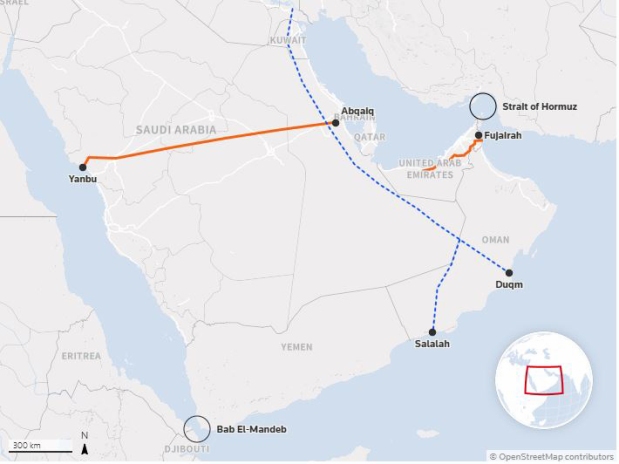
Approximate pipeline routes
&uuid=(email))