

Bahrain provides a much-welcomed and needed ‘safe space’ for policymakers at the annual Manama Dialogue to debate and discuss pressing global and regional issues.
Leading decision makers from around the world are expected to attend the 21st International Institute for Strategic Studies (IISS) Regional Security Summit: The Manama Dialogue 2025, which will be held from October 31 to November 2 at The Ritz-Carlton Bahrain.
The annual summit provides a platform for experts, decision makers and governmental delegations to exchange views on regional security challenges.
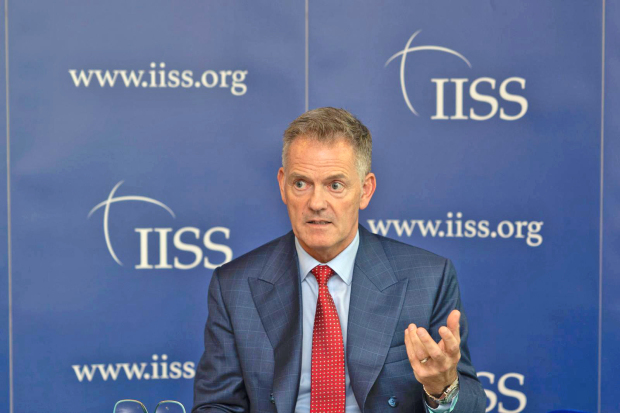
Speaking ahead of the meeting, the think tank’s Middle East executive director, Air Marshal (Retired) Martin Sampson, told the media yesterday that the stage is set to welcome world leaders for the three-day forum.
“This is our 21st year hosting the Manama Dialogue, which is a huge testament to the commitment of Bahrain’s leadership to provide such a platform,” Mr Sampson told reporters yesterday.
“The theme of this year’s event is ‘Regional Power and Statecraft Amidst Global Change’.”
Mr Sampson said with the current geopolitical changes, transformations and even conflicts, the Manama Dialogue ‘provides a safe space, just what we need at this moment of time for debate, discussion and the exchange of views’.
“I think the role of the Dialogue is particularly important to engage and contribute ahead of the GCC Summit hosted in Bahrain (December) and the start of the kingdom’s term (2026-2027) at the United Nations Security Council,” he added.
“This is an opportunity for people to test their ideas and thoughts with a broader audience, but also engage discreetly and with diplomacy.”
Bahrain was elected in June this year as a non-permanent member of the UN Security Council following a vote at the UN General Assembly in New York, where it received an overwhelming 186 out of 187 votes.
The security summit, which has been held since 2004, has helped Bahrain build up its soft power by inviting top government leaders to discuss key issues facing the region and elsewhere.
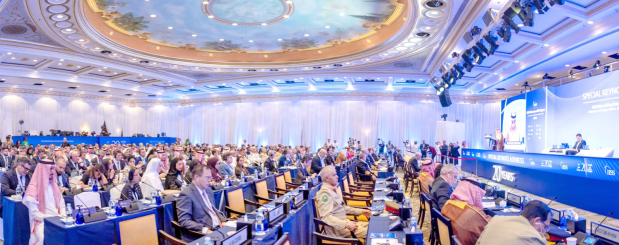
Attendees at one of the plenary sessions of the summit last year
This year the meeting of world leaders in Bahrain takes place at a crucial juncture, with the ongoing war in Gaza and Ukraine, as well as other conflicts.
Mr Sampson, when asked about participation from delegates from different countries, said: “The door is always open to all.
“Countries close to conflict will also be at the dialogue to explain and seek support,” he said.
“We have been engaging with the Syrian leadership over the past months and weeks, and are hoping for a strong delegation (to attend).”
Mr Sampson added last year’s dialogue witnessed more than 65 nations being represented and organisers expect a similar representation this time.
He added that some countries that had never attended the dialogue, have reached out to find out more about the possibility of participating.
“We try and get as many countries represented as possible,” he said.
“It’s easy to compete and fight but difficult to talk, and the Manama Dialogue is a catalyst of discussion playing a positive role.”
Mr Sampon said they have carefully prepared an agenda this year based on an analysis of the event last year, expert views, and selecting key topics to be discussed.
The event kicks off on October 31 with bilateral meetings between ministers and officials, followed by an opening reception and a keynote address later in the day, according to the agenda released by the think tank.
The following day world leaders and experts will take part in a number of plenary sessions on: US Statecraft and Middle East Stability, The Future of Global Security Governance, Securing the Gulf: Diplomacy, Economics and Defence and fourth plenary session on The Geopolitics or Energy: Technology, Trade and Power.
Invitation-only private lunches and other panel discussions will also be hosted on the day.
The last day features three plenary sessions that will focus on: Managing Political Transition in the Levant (large area in the Eastern Mediterranean), Maritime Security as a Regional and Global Responsibility, and Another Nuclear Age? Strategic Risk and Opportunity.
The summit will additionally feature a Young Leaders Programme that aims to provide young people with a forum at which they can air policy suggestions that address regional challenges.
It enables them to participate directly in the thinking behind and design of effective policies for the region.
Last year, the key speaker at the event was Foreign Minister Dr Abdullatif Al Zayani, who spoke on a wide range of issues including greater security integration between Bahrain and the UK, the war on Gaza and the conflicts in Lebanon and Syria.
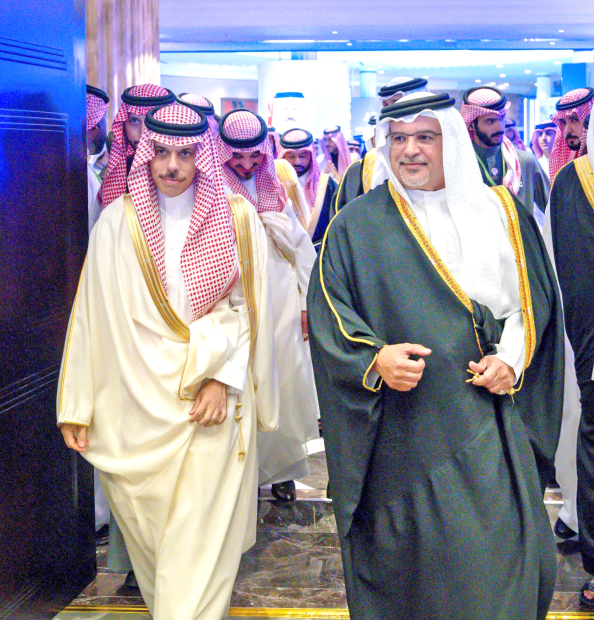
HRH Prince Salman arriving at last year’s summit with Saudi Foreign Minister Prince Faisal bin Farhan Al Saud
His Royal Highness Prince Salman bin Hamad Al Khalifa, Crown Prince, Deputy Supreme Commander of the Armed Forces and Prime Minister, was the keynote speaker at the 2023 Manama Dialogue.
Conflict
In his address, HRH Prince Salman had called the Palestine-Israel conflict an ‘open wound in the Middle East for the past 80 years’.
At the 2022 Manama Dialogue, His Majesty King Hamad’s representative for humanitarian work and youth affairs Shaikh Nasser bin Hamad Al Khalifa delivered a speech in which he highlighted that the kingdom was ready to play any role required in resolving the Russia-Ukraine conflict and do its part in promoting peace and coexistence.
Some of the big names to have appeared as speakers at the summit previously are former US secretary of state Hillary Clinton, Jordan’s King Abdullah II, Egyptian President Abdel Fattah Al Sisi and former British prime minister Boris Johnson in his capacity as foreign secretary in 2016.
sandy@gdnmedia.bh
&uuid=(email))