

The bus services launched by Bahrain Public Transport Company (BPTC) has undeniably provided a valuable and affordable means of transportation to commuters across the kingdom.
Until the late 1990s, the country faced an acute shortage of reliable public transport, during which time taxis often took advantage of helpless passengers. The introduction of the bus service filled this gap commendably by covering a wide area and continuously expanding routes based on public need. In this regard, BPTC buses operate as a genuine public service provider.
However, despite its extensive network and low-cost, comfortable buses, the service has not succeeded in bringing about a true public transport revolution – one that would attract the majority of citizens and significantly reduce traffic congestion, as seen in cities such as London.
Recently, I read an anecdote about the editor of The Washington Post, who, after his car developed a fault, chose to walk to a nearby underground station rather than take a taxi. Such examples highlight how deeply public transport is embedded in daily life elsewhere – something we have yet to achieve.
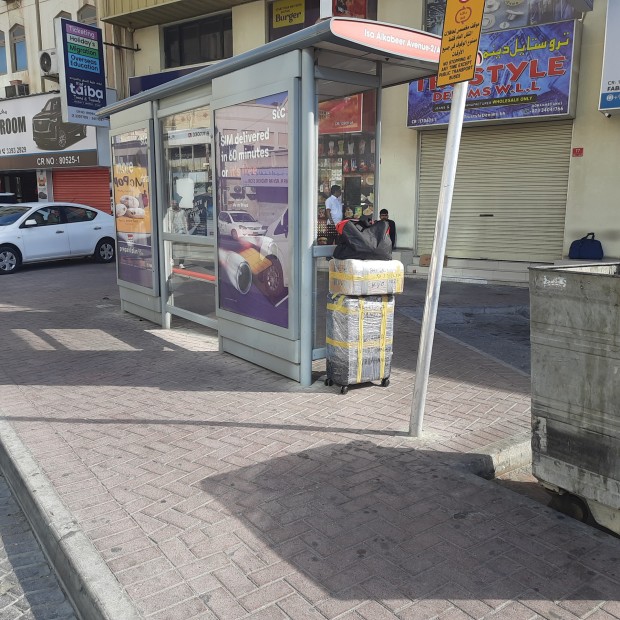
One important aspect that appears to have been overlooked is the condition and design of bus stops. Except for three or four main terminals, most bus stops, I believe, are uncomfortable. Two weeks ago, at midday, I was waiting at the bus stop on the pavement near the mosque beside KFC, opposite Manama Post Office. It is a busy stop, with around a dozen passengers regularly waiting. When rain started suddenly, the inadequacy of the shelter became painfully evident.
Most bus stops provide seating for only three passengers, with narrow benches barely five inches wide. The roof extends only a few inches on either side, offering minimal protection. As a result, only seven or eight passengers could stand shoulder-to-shoulder beneath it, with only their heads protected while rain drenched their legs and shoes. The remaining passengers stood completely exposed.
Even worse examples are the two bus stops in front of Shifa Al Jazira Hospital, Manama. One stop faces inward towards a garden, and the other towards nearby shoppers. Consequently, waiting passengers cannot see approaching buses, and bus drivers do not consider it their responsibility to sound the horn to alert them. Buses pass by unnoticed. Having suffered repeated missed buses, many passengers prefer standing on the footpath for an hour or more rather than sitting inside these shelters.
As a simple first step towards improvement, I suggest reversing the front-facing direction of these two bus stops so that passengers can see incoming buses. I assure the bus management that such a correction would not require even half an inch of additional space.
I wish to share a personal experience to underline this issue.
On January 9, I left Al Shifa Hospital in a feverish condition. Standing on the footpath was difficult, so I entered the bus stop to sit, though in an extremely painful posture. My body faced the greenery inside the garden, while my neck had to be turned almost 60 degrees to the right to observe the road. Due to the straight road alignment, an approaching bus becomes visible only when it reaches the edge of the hospital building – barely three metres from the kerb.
At 10.05pm, I finally saw the bus arriving. Before I could step out, it passed without stopping. What is the logic or rationale behind placing bus stops in a reverse-facing position where neither passengers nor drivers can see each other clearly?
I hope small but meaningful changes can be made to improve the daily experience of ordinary commuters.
Muhammad
&uuid=(email))