

More than 190,000 Bahrainis are currently receiving cash compensation following the removal of meat subsidies, while almost 138,000 families benefit from the cost-of-living allowance and 17,000 individuals receive social insurance support.
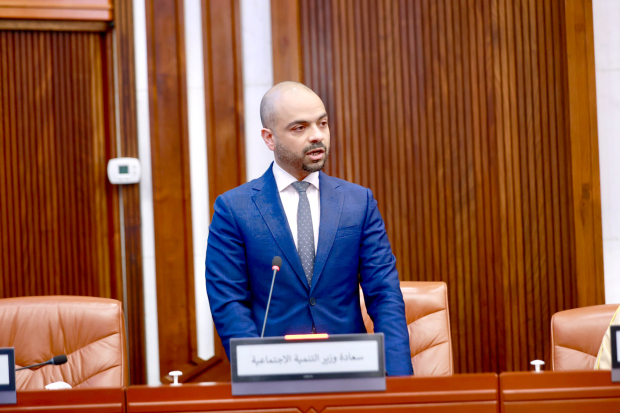
These figures took centre stage yesterday as Social Development Minister Osama Al Alawi presented a data‑driven defence of the kingdom’s social protection system.
Responding to a series of parliamentary questions, Mr Al Alawi outlined detailed, programme‑by‑programme statistics, stressing that structured eligibility criteria are in place to ensure both fairness and long‑term sustainability. “Each programme has its own standards, conditions and target categories,” he said. “Applying these criteria ensures that support reaches the most needy.”
Topping the list in terms of scale is the cash compensation programme for lifting meat subsidies, which – as of February 2026 – supports 192,530 beneficiaries.
The minister stressed that this scheme is not income-based.
“The meat subsidy compensation programme is not linked to an income or salary ceiling,” he said, noting its broad reach across society.
Next in scale is the Financial Support Programme – widely known as the cost-of-living (anti-inflation) allowance – benefiting 137,984 citizens across three tiers. Heads of households earning up to BD1,000 per month qualify, with payments revised in December 2025 to BD130, BD97 and BD75 across three tiers.
“The majority of social insurance beneficiaries receive the highest category of BD130 per month, in addition to their social assistance,” Mr Al Alawi explained. “Any change to these tiers automatically benefits them.”
He reminded MPs that a 10 per cent increase had previously been applied in January 2022 to both social insurance and financial support payments.
Under the Social Insurance Programme, 17,710 individuals were benefiting as of February this year. The figures are calculated on an individual – and not household – basis. The breakdown includes 5,656 families, 5,281 elderly citizens, 4,297 divorced women, 721 unmarried daughters, 694 widows, 424 sons, 269 individuals unable to work, 133 persons with disabilities, 129 orphans, 57 abandoned families and 49 families of prisoners.
Importantly, all social insurance beneficiaries automatically receive the cost-of-living allowance.
The minister revealed that BD22 million had been allocated for social assistance in 2025, and BD23m in 2026 under the 2025-2026 state budget law.
“The compound annual growth rate of beneficiaries over recent years is less than one per cent annually,” he said. “This reflects stability in beneficiary numbers.”
Meanwhile, 15,558 individuals benefit from disability allowances, which are not subject to income ceilings.
Those classified under general disabilities receive BD100 per month, while severe disability cases receive a doubled allocation under criteria introduced in 2023.
“Benefiting from one programme does not prevent a citizen from receiving other allocations,” Mr Al Alawi stressed. “Some beneficiaries get social insurance, the cost-of-living allowance and disability benefits at the same time.”
Beyond cash assistance, the ministry allocates BD1.2m annually to support 12 licensed rehabilitation centres serving around 450 students with disabilities. Assistive devices are provided to people with disabilities earning up to BD1,500 per month, and to elderly citizens earning up to BD1,000.
Compensation for residential fire damage is also available for those earning up to BD1,500.
The minister emphasised that programme criteria and payment levels undergo periodic review in line with living standards and best practices.
mohammed@gdnmedia.bh
&uuid=(email))