

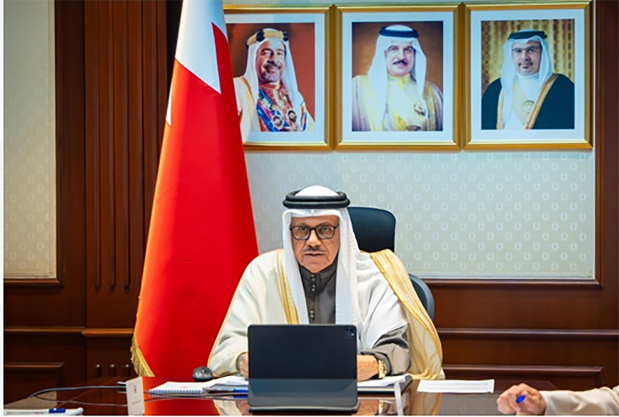
Foreign Ministers of the GCC and the European Union strongly condemned the unjustifiable Iranian attacks against the GCC countries which threaten regional and global security and called on Iran to immediately stop the strikes.
It came during an extraordinary meeting via video conference yesterday to discuss the serious escalation in the Middle East and Tehran’s attacks on GCC states.
The meeting was chaired by Foreign Minister and current President of the Ministerial Council of the GCC Dr Abdullatif Al Zayani, with the participation of High Representative of the European Union for Foreign Affairs and Security Policy and European Commission Vice President Kaja Kallas, along with GCC and EU foreign ministers. GCC Secretary-General Jassim Mohammed Al Budaiwi also attended.
Dr Al Zayani said that the meeting comes amid dangerous and difficult circumstances facing the region, as GCC countries continue to face ongoing and unjustified attacks by Iran.
“The attacks have targeted civilian infrastructure with more than one thousand drones and hundreds of ballistic missiles, striking homes, hotels, shopping centres, ports, airports, and energy facilities, resulting in casualties, injuries, and significant material damage,” he said.
“The indiscriminate attacks against civilian property constitute a grave violation of international law, and GCC countries categorically reject any justification put forward to defend them,” he added.
At the meeting, ministers reiterated their commitment to regional stability and called for protection of civilians and full respect of international law, humanitarian law and the obligation to abide by the principles of the United Nations Charter.
They recalled that they consistently urged Iran to curb its nuclear and ballistic missile programmes, refrain from destabilising activities in the region and in Europe, and to cease the appalling violence against its own people.
The meeting highlighted the significant damage caused by the recent indiscriminate Iranian attacks against the GCC member states, which targeted civilian infrastructure, including oil facilities, service facilities and residential areas, threatening the security, safety and lives of civilians.
The ministers highlighted the extensive diplomatic efforts by the EU and its member states and the GCC member states prior to the attacks, as well the latter’s commitment that their territories would not be used to launch attacks against Iran.
They reaffirmed their unwavering commitment to dialogue and diplomacy as means to resolve the crisis, commending the constructive role of Oman in this regard, and highlighted the need to restore regional stability and security.
They affirmed that the GCC states have the right to take all necessary measures to defend their security and stability and protect their territories, citizens and residents in order to restore international peace and security.
The ministers also recalled the responsibility of the UN Security Council in restoring and maintaining international peace and security.
The ministers agreed to joint diplomatic efforts to bring about a lasting solution to prevent Iran from acquiring a nuclear weapon, to cease production and proliferation of ballistic missiles, unmanned aerial vehicles and any technologies that threaten the security of the region and beyond, as well as to refrain from destabilising activities in the region and in Europe, and ultimately allow the Iranian people to determine their future.
They reaffirmed the importance of safeguarding regional air space, maritime routes, and freedom of navigation, including in the Strait of Hormuz and Bab el Mandeb, as well as the safety and security of supply chains and the stability of global energy markets.
The ministers also stressed the need to safeguard regional airspace and maritime routes, as well as energy security and nuclear safety.
The European Union and its Member States said they will continue to make every effort to allow for the safe departure of their citizens in close co-operation with the GCC member states.
Read more:
Residential tower and two hotels hit by Iranian attacks
Most British residents opt ‘to shelter in place’
UK praises Bahrain’s steps to ensure safety
WE’RE PREPARED: HRH Prince Salman visits the General Directorate of Civil Defence and the National Centre for Civil Emergency Management
Parents urged to monitor children’s online activities
&uuid=(email))