

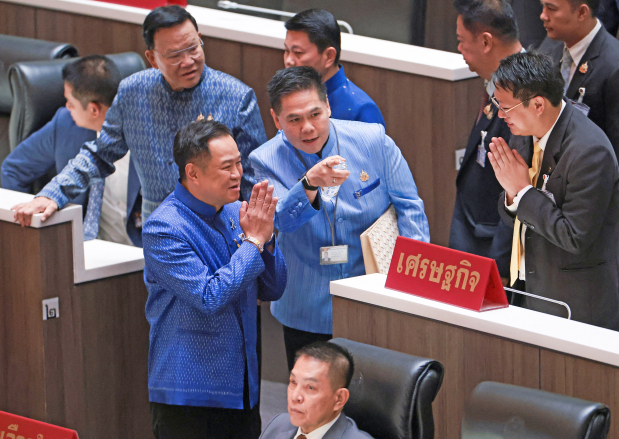
Thailand’s Anutin Charnvirakul sailed through a parliamentary vote yesterday to become the first reelected prime minister in two decades, a fresh mandate that could bring rare stability for the turbulent politics of the Southeast Asian nation.
The Bhumjaithai Party’s Anutin led from the start in rout of his biggest rival, Natthaphong Ruengpanyawut, leader of the progressive People’s Party and the surprise runner-up last month in an election it had been widely expected to win.
Anutin won the backing of 293 of parliament’s 499 members yesterday, more than twice the 119 votes Natthaphong secured.
He offered no immediate comment on his victory, but headed into a meeting on energy security.
“Thailand has no issues and is able to still buy oil,” Anutin said after the meeting. “We will ensure public confidence.”
Earlier, dressed in Thai traditional attire in his party’s hue of blue, a beaming Anutin had greeted a succession of allies in parliament, shaking hands and posing for photographs.
In a stunning turnaround for a party that had struggled to make its mark in Thai politics, Bhumjaithai decisively won last month’s election, riding on a wave of nationalism unleashed by military clashes with neighbouring Cambodia last year.
Much of Anutin’s success comes from his opportunism in seizing on the decline of the once dominant Pheu Thai party, first by abandoning its coalition government and then manoeuvring swiftly to form his own after a court sacked a second prime minister in the space of just over a year.
Bhumjaithai’s coalition pact with the politically bruised Pheu Thai and a crew of small parties stood firm in yesterday’s vote, as Anutin comfortably reached the necessary threshold of 51 per cent.
Earlier, Anutin, 59, had pledged to immediately start forming a cabinet and resolving Thailand’s problems.
“Your voices are equally heard,” he told legislators from outside his alliance. “I’m ready to accept suggestions ... We all have the same goals – the wellbeing of the people.”
Staunch royalist Anutin weathered two decades of upheaval in tumultuous Thai politics by strategically positioning his party between elites warring in an intractable power struggle to ensure its role in successive coalition governments.
He now has his first clear mandate to lead a country with a long-stuttering economy shackled by massive household debt and facing headwinds from trade uncertainty and the fallout of the US-Israeli war on Iran.
A political veteran and son of a former cabinet minister who once ran his family’s construction firm, Anutin is a former deputy premier, interior minister and health minister who served as Thailand’s Covid-19 tsar.
&uuid=(email))