

Historic mosques and cemeteries across Bahrain – some dating back more than five centuries – are set to be restored under a multi-million-dinar programme.
The year-long initiative, led by the General Directorate of Jaffari Waqf in co-ordination with the Bahrain Authority for Culture and Antiquities (Baca), will revitalise iconic religious landmarks with modern facilities while preserving their archaeological and cultural value.
Officials have described the project as one of the most ambitious heritage-preservation efforts in recent years.
Among the sites earmarked for redevelopment are the centuries-old Nabih Saleh Mosque, Shaikh Maitham Mosque, Shaikh Jassim Mosque, Al A’ali Mosque, as well as major burial grounds including Hoora Cemetery and Abu Anbara Cemetery.
Speaking during a meeting of the Capital Trustees Board in Tubli yesterday, Jaffari Waqf engineering services and maintenance head Hassan Al Khatem stressed that the works go far beyond demolition and reconstruction.
“This is not simply a demolition and rebuild operation,” said Mr Al Khatem. “It is a delicate balance between restoration and modernisation. Wherever necessary, we have altered our designs to protect historical features, particularly in sites like Abu Anbara where recent Islamic archaeological artefacts have been unearthed.”
One of the centrepieces of the programme is the transformation of Nabih Saleh Mosque, whose shrine dates back to 1784 and remains a focal point for spiritual gatherings.
“This project is about more than bricks and mortar, Nabih Saleh will be developed into a state-of-the-art religious destination,” Mr Al Khatem revealed. “We envision a sprawling complex with expanded prayer areas, visitors’ rooms, educational and recreational facilities, a shopping complex and an enhanced graveyard.”
Capital Trustees Board chairman Saleh Tarradah highlighted the site’s regional significance.
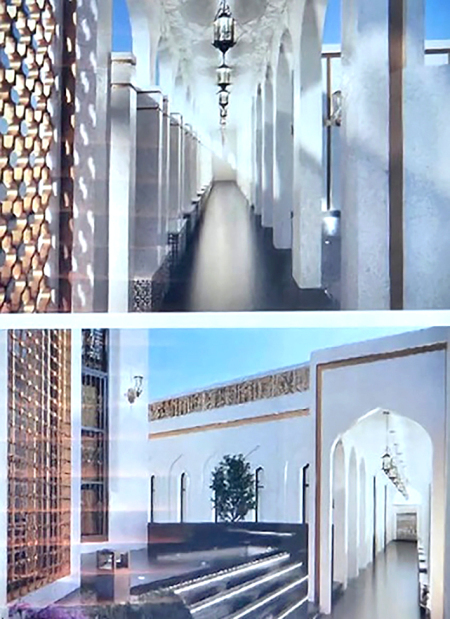
Interior designs for the Shaikh Maitham Mosque
“It is a landmark not just for Bahrain, but for the Gulf,” said Mr Tarradah. “In the past, people would sail to the island to seek blessings. Even today, the mosque remains a hub for spiritual gatherings. This upgrade is long overdue and it will re-establish its status as a leading religious and cultural destination.”
Dr Khulood Al Qattan, vice-chairwoman of the board, welcomed the focus on such vital religious locations.
“The current list of sites needs immediate attention, and the revamp of Nabih Saleh, in particular, is a welcome step,” she said. “The site is already popular among Bahrainis and visitors for its spiritual significance. With these upgrades, it will become a truly vibrant destination.”
Other projects include structural modifications to Shaikh Jassim Mosque necessitated by the Al Fateh Highway expansion, with the Works Ministry undertaking a comprehensive revamp of the site to compensate for the loss of affected space. Hoora Cemetery will undergo a comprehensive upgrade including a new secure perimeter fence, embalming and washing facilities, multi-purpose halls, additional prayer areas and improved organisation of graves for better access and dignity. At Abu Anbara Cemetery, renovation plans have been revised to preserve newly discovered Islamic relics.
General Directorate of Jaffari Waqf director-general Abduljalil Al Hayki said the scale of responsibility is vast.
“We have 422 mosques, 404 ma’atams and 56 cemeteries under the General Directorate in the Capital Governorate alone,” he said. “Work is currently underway, or scheduled for this year, on eight mosques, two ma’atams and three cemeteries.”
He also pointed to challenges associated with historical endowments. “In some cases, we face difficulties approving endowments for renovation or maintenance due to missing documentation, as many of these sites predate formal registration systems,” Mr Al Hayki explained. “Endowments must serve a clear religious purpose; for instance, public toilets cannot be funded unless they are temporary facilities for religious occasions or form part of a permanent place of worship.” Capital Trustees Authority director-general Alya Yousif said land verification was key to unlocking progress.“A proper survey from the Survey and Land Registration Bureau can help identify property and allow us to grant municipal permissions,” she said. “We must ensure there is no trespass on private land. If documents confirm the site is, for example, a cemetery, then survey permits can be issued accordingly.”
Alongside restoration, new religious infrastructure has also been planned in communities such as East Sitra Town.
mohammed@gdnmedia.bh
&uuid=(email))