

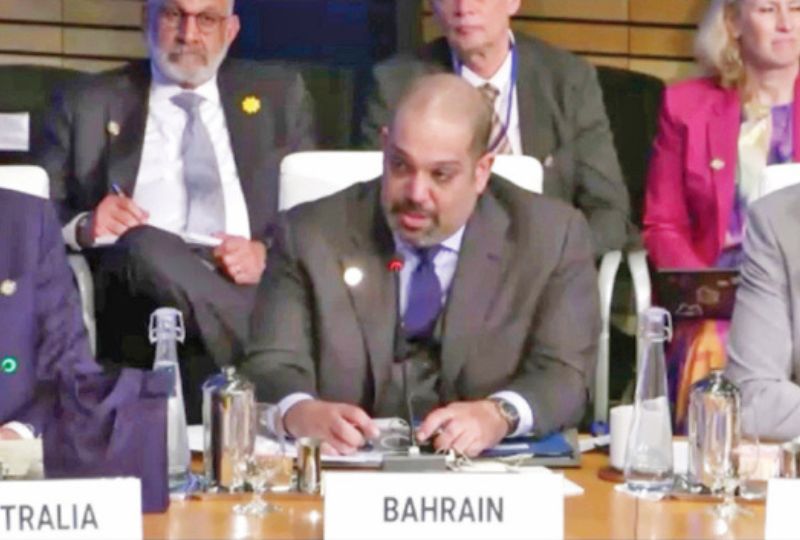
Finance and National Economy Minister Shaikh Salman bin Khalifa Al Khalifa delivered a statement before the Development Committee on behalf of the Arab Group countries and the Maldives, represented by Bahrain, during his participation in the 2026 Spring Meetings of the International Monetary Fund and the World Bank Group, in Washington.
He said that for 40 days and 40 nights, peaceful and development-focused countries of the GCC and Jordan had been subjected to a barrage of unjustified and indiscriminate attacks involving ballistic missiles and drones launched by Iran.
The sustained assaults over that period, wave after wave, exceeded 5,000 missiles and drones, including more than 1,000 during the first 24 hours alone, deliberately targeting civilians, residential areas, educational institutions, commercial buildings, airports, ports, power stations, oil and gas facilities, and other vital infrastructure, he noted.
“The attacks resulted in casualties, injuries and extensive material damage across all participating countries,” he said, adding that they stood strong today, proud of their armed forces, security services, civil defence personnel, and the citizens and residents who had demonstrated unwavering resilience and steadfastness in the face of the aggression.
Shaikh Salman expressed profound gratitude to regional partners who had united in confronting the attacks, to the US and international allies who had stood side by side in defence of their countries, and to the international community, which had sent a clear and decisive message through the historic adoption of United Nations Security Council Resolution 2817.
The minister stressed that Iran’s attempts to disrupt navigation in the Strait of Hormuz constituted an act of economic terrorism, given the severe repercussions for global supply chains.
More than 20 per cent of the world’s oil and liquefied natural gas supplies pass through the Strait, along with over 27pc of global aluminium exports and more than 30pc of fertiliser exports, amid what he described as the greatest disruption to global supply chains since the Second World War, requiring a concerted international response.
He also highlighted the importance of reaching a permanent ceasefire in Lebanon and ensuring strong support to improve the humanitarian situation in the Gaza Strip.
Shaikh Salman emphasised that the world was facing a struggle between those seeking to build a peaceful and prosperous future for the region and the wider world, and those attempting to drag it back into the Middle Ages, calling on the World Bank and the international community to provide their support.
&uuid=(email))