

The message attributed to Iran’s Supreme Leader Mojtaba Khamenei comes as a recycled political narrative, built on repeating claims and falsehoods about the Arab Gulf states, in an attempt to impose a one-sided vision on a region undergoing major developmental and strategic transformations, while firmly upholding its principles of sovereignty, good neighbourliness, and respect for international law.
The remarks by Mojtaba – whose status is unclear, whether alive or dead – about a ‘new chapter for the Gulf and the Strait of Hormuz’ cannot be separated from a political context aimed at reshaping reality according to illusions of hollow victories promoted by the Iranian regime.
Meanwhile, facts on the ground confirm that the Arab Gulf states alone have the right to determine their priorities regarding collective security and strategies, and to map out their alliances based on their national visions and supreme interests.
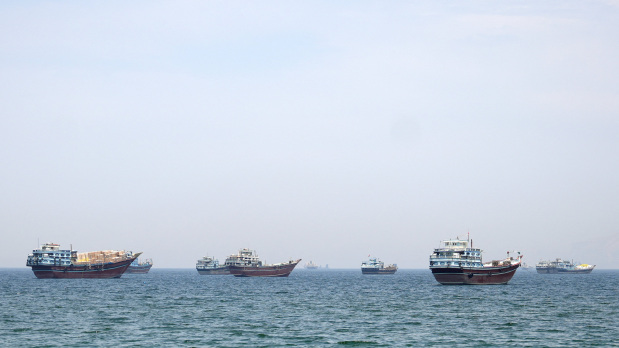
When Mojtaba Khamenei, or other Iranian officials, speak of a shared destiny or a new management of the Strait of Hormuz, they ignore a fundamental fact: this waterway is not the political property of any party.
Rather, it is an international artery governed by the rules of international maritime law, serving the global economy as a whole, and must not be turned into a political tool, a means of coercion, or a lever for imposing influence.
Through its policies and actions, Tehran has shattered all avenues of engagement with the Arab Gulf states when it carried out aggressive and unjust attacks targeting the resources and interests of GCC countries – despite the fact that these states neither initiated any aggression nor served as a platform for targeting Iran.
On the contrary, Gulf states have consistently called for stability and de-escalation.
The Iranian discourse about unity of destiny or a bright future for the region contradicts the reality experienced by Gulf states, which have faced repeated threats and attempts to undermine security and stability – whether through political escalation or direct targeting of regional security.
This has led to a severe loss of trust, as highlighted in the statement issued by the recent GCC consultative summit in Jeddah.
The treacherous Iranian attacks have significantly eroded GCC countries’ trust in Iran, requiring Iran to take serious steps to rebuild that trust.
This is a clear message: the damage caused by Iranian aggression cannot be repaired through false statements that merely repeat attempts to impose an expansionist Iranian agenda on the region through blatant interference in its affairs.
These unlawful Iranian attacks constitute a serious violation of the United Nations Charter, international law, and the principles of good neighbourliness.
Rebuilding trust cannot be achieved through political statements or media messages – it requires a genuine change in political behaviour and a commitment to respecting sovereignty and non-interference in the internal affairs of states.
When Mojtaba Khamenei speaks of managing the Strait of Hormuz or imposing “new rules”, it amounts to little more than an effort to promote yet another false narrative, adding to a series of misleading claims in his message.
Any attempt to hold the Strait of Hormuz hostage as a political tool amounts to economic terrorism in every sense of the word, as it violates international rules governing transit through waterways, threatens global trade and supply chains, and puts the stability of the international economy at risk.
More than 100 countries have expressed their rejection of any Iranian measures to close the Strait of Hormuz or exploit it as a political tool, reflecting a broad international awareness of the dangers of such an approach – not only for Gulf states but for the entire world.
It affects the livelihoods of millions who depend on safe and stable maritime routes.
Mojtaba Khamenei and other Iranian officials should refrain from interfering in the affairs of others.
They should keep their hands and rhetoric away from the Arab Gulf states.
These countries, which have achieved significant developmental and economic progress thanks to the visions of their leaders, have chosen the path of construction and development – not war and destruction.
This makes them more committed to regional stability and more determined to protect their achievements from any attempts to undermine security or impose influence.
In contrast, the Iranian regime’s strategic record, as reflected in its policies, is one rooted in exporting violence and destruction and fuelling crises across the region.
This has also been mirrored domestically, as Iran faces severe economic challenges, delays in salary payments, and high inflation exceeding 70 per cent, highlighting the failure of expansionist policies at the expense of internal development.
Statements about ‘managing the Gulf’ or ‘reshaping the region’ can only be viewed as an extension of rhetoric that disregards the realities of geography and sovereignty, seeking to impose a narrative that exists solely in political propaganda.
The enduring truth is that the Arab Gulf states hold the authority over their own security and are fully capable of protecting their sovereignty.
What has been issued by Mojtaba Khamenei reflects nothing more than the continuation of an approach rooted in blatant interference in the affairs of Arab Gulf states, along with efforts to impose expansionist agendas that are no longer acceptable in an international system founded on sovereignty and mutual respect.
Meanwhile, the Gulf states continue on their developmental path, strengthening international partnerships and consolidating stability – far removed from rhetoric of falsehoods and claims – ensuring a future grounded in security, development, and prosperity for all their peoples.
&uuid=(email))