

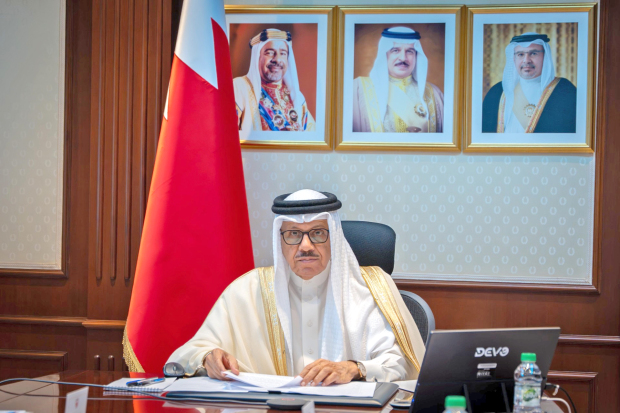
The Foreign Minister has stressed that recent developments in the region represent an extremely dangerous reality, pointing out that approximately 23,000 sailors have been affected by them while nearly 1,600 vessels from 87 countries remain stranded in the Arabian Gulf.
Dr Abdullatif Al Zayani also pointed out the tragic death of 10 sailors and the recent attack on a French vessel while crossing the strait.
He noted that more than 32 attacks have been reported on ships since Iran began what he described as its ‘unlawful blockade’.
The impact of these developments on the Mediterranean-European Union Group Countries (MED9) and their maritime interests is both clear and direct, Dr Al Zayani said, warning that figures related to the member states demonstrate the serious repercussions for maritime navigation, supply chains and the safety of seafarers.
The remarks came during his participation in the online ministerial meeting of the MED9, the Arab League, and the Western Balkan countries, to discuss the repercussions of the recent developments in the region and the impact of the disruption of navigation through the Strait of Hormuz on regional and global stability.
Dr Al Zayani stated that the new draft resolution to be presented to the United Nations Security Council was jointly drafted by the US and Bahrain, with the support of the five GCC states. It aims to address Iran’s continued obstruction of maritime navigation in the Strait of Hormuz over the past two months.
“The draft resolution reaffirms the rules of international law and calls on Iran to cease attacks on commercial vessels, disclose and remove naval mines, stop imposing transit fees, and facilitate a safe humanitarian corridor.”
“It sends a clear message that the Security Council stands ready to consider additional measures should Iran fail to comply.”
&uuid=(email))