

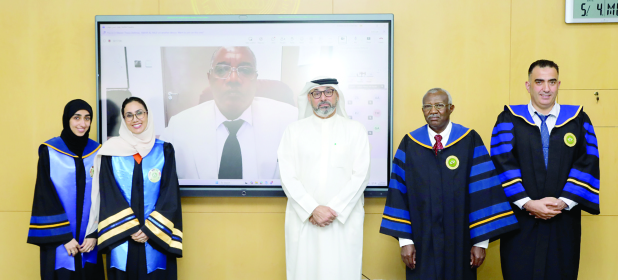
A new study has found that the use of virtual patient simulations (VPS) can significantly enhance the clinical and psychological skills of medical students, while also underscoring the need for further development in communication-based training.
The findings were presented by Zahraa Shihab, a student in the Digital Education Programme at the College of Education, Administrative and Technical Sciences at Arabian Gulf University (AGU), during the defence of her master’s thesis.
Her work, titled ‘The Effectiveness of Virtual Patient Simulations in Clinical Competency Training and User Experience Among Medical Students’, was completed as part of the academic outputs of the His Majesty King Hamad Chair in Digital Education.
The research provided detailed insights into gaps in communication skills and offered recommendations for enhancing virtual simulation technologies in the Arab and Gulf region.
It adopted a mixed-methods approach and used an instructional design network based on the Analyse, Design, Develop, Implement and Evaluate model, helping ensure the accuracy and reliability of the findings.
According to the study, students’ overall clinical performance improved considerably following the redesign of the virtual simulation scenario, achieving a performance rate of 87.61 per cent, surpassing the 80pc proficiency benchmark. The study also reported high levels of student satisfaction with the simulation in terms of usability and educational value, recording an average effectiveness score of 4.6 out of five.
Participants noted that the system improved clarity, built confidence, and reduced stress associated with psychological interviews.
Despite these positive outcomes, the research identified shortcomings in communication training within the simulation environment. Students scored 71.44pc in communication skills, a result attributed to limited dialogue options and insufficient emotional realism in interactions with virtual patients.
Participants recommended further enhancing the platform through the integration of artificial intelligence and voice interaction technologies to create more realistic and engaging communication experiences.
The study concluded that virtual patient simulations represent an effective and scalable educational tool in psychiatric training, but highlighted the need for technical enhancements to address communication skill gaps.
Education and Curriculum department head and the thesis’s primary supervisor Prof Dr Muhammad Al-Ajab described the research as a milestone.
According to the university, the Master of Science programme in Digital Education is the first of its kind in the Gulf region and the wider Arab world, and aims to train specialised professionals capable of designing, implementing, and evaluating innovative digital education solutions in line with contemporary requirements and international quality standards.
&uuid=(email))