

GULF WEEKLY -
A local art gallery is set to host London-based Palestinian artist Haya Natsheh in an online workshop about traditional Tatreez hand-embroidery, coinciding with the Nakba Day anniversary this month.
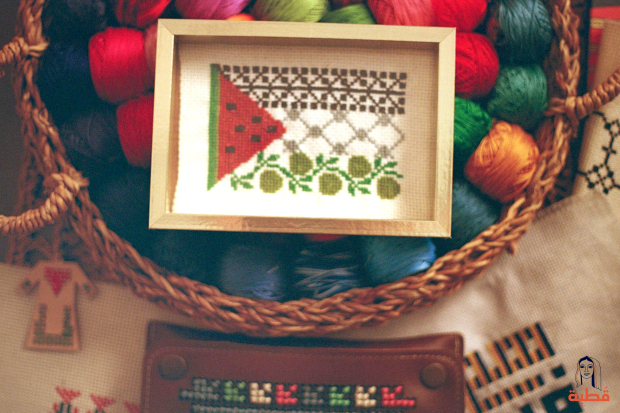
The session entitled The First Stitch: An Introduction to the Language of Tatreez will feature a guided introduction to Palestinian cross-stitch, combining cultural context with hands-on practice.
Art Concept located in Andalus Garden is staging the event on May 24 via the Agora platform. It was preceded by an online talk on the same topic delivered by Haya the previous week.
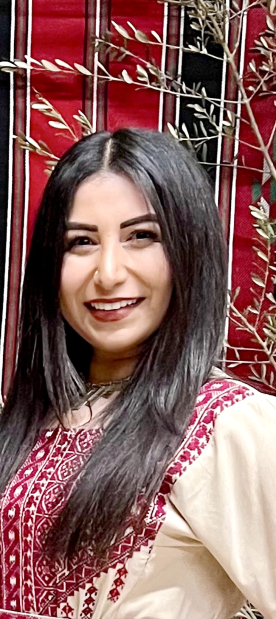
Creative: Haya
Nakba Day, observed on May 15, commemorates the ‘catastrophe’ and displacement of Palestinians in 1948. The timely workshop offers participants the space to revisit the historic event, empathising with the Palestinian cause while also delving into the country’s rich cultural heritage.
Tatreez is an ancient craft dating back centuries and brings alive intricate, colourful geometric motifs passed down through generations. It is primarily sewn as cross-stitch – ‘falahi’ or peasant embroidery – on women’s garments.
While each Palestinian village uses distinct motifs and colour palettes, some common patterns could carry deep meanings. The cypress tree (sarw), for instance, symbolises ‘connection to the land’ and birds, often depicted perched on branches or paired with blooms, represent ‘freedom’.
In 2021, UNESCO officially recognised the craft as Intangible Cultural Heritage, acknowledging it as a living practice carried across generations.
While fashion enthusiasts around the world have always revered the iconic designs, the patterns have resurfaced in recent times of political conflict, attracting significant attention.
“There has certainly been increased global visibility around Palestinian symbols and cultural expression since October 2023, including Tatreez,” Haya told GulfWeekly.
“More people are seeking to learn about Palestinian history and identity through cultural forms, and embroidery has become one of the most visible entry points into those conversations,” she added.
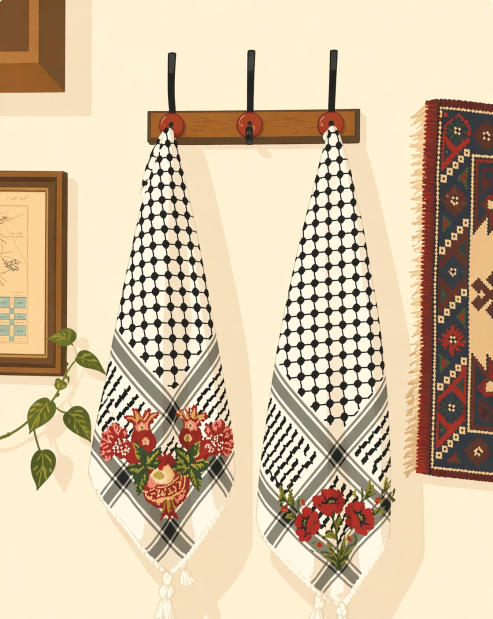
Iconic: A digital illustration of the traditional Palestinian keffiyeh depicting Tatreez
Haya believes that while embroidery traditions exist across the Arab world and in many cultures globally, what makes Palestinian Tatreez distinct is the depth and specificity of its visual language.
“Historically, Palestinian embroidery functioned almost as a social map. Through motifs, colours, stitching styles and placement, women could often identify someone’s village, region, social status, or marital situation simply by reading the dress she wore.
“Tatreez is also deeply tied to land and geography. You see the environment entering the cloth – cypress trees from Jaffa, grape motifs from Hebron, palm motifs from Ramallah, desert geometry from the south. The embroidery reflects agricultural life, movement and trade routes and historical change across centuries,” added the creative talent, who works across both the traditional falahi stitch and tahriri – a less commonly practiced embroidery technique historically associated with Bethlehem.
“What also sets Tatreez apart today is that it carries a political weight alongside its cultural one. Palestinian embroidery has repeatedly faced appropriation and attempts to detach it from its origins, which made preservation and documentation even more urgent.”
In a time when cheap knockoffs are fast replacing heritage arts and crafts, Haya encourages mindfulness. However, she remains positive.
“I do not think these traditions are disappearing entirely. Many communities around the world – especially women, artisans, and younger generations – are actively reclaiming and preserving them in new ways. The real challenge is not simply whether a motif survives visually, but whether the knowledge behind it survives too,” added the expert, who is developing her work in research and writing, with the aim of contributing to broader conversations on Palestinian textile traditions and their cultural significance.
For more information, follow @artconceptbh on Instagram.
&uuid=(email))