

Bahrain has emerged as an attractive investment destination, driven by its business-friendly policies and an efficient public sector, according to a new report.
Featured for the first time this year, Bahrain makes its mark in the Chandler Good Government Index (CGGI), joining 13 other new countries in the latest report.
Compiled by the Singapore-based Chandler Governance Group, the index evaluates nations across seven pillars – leadership and foresight, robust laws and policies, strong institutions, financial stewardship, attractive marketplace, global influence and reputation and helping people rise.
Bahrain ranks second among GCC countries in the ‘attractive marketplace’ category, placing seventh globally. The UAE ranks sixth, followed by Oman (12), Qatar (31), Saudi Arabia (35) and Kuwait (72).
The kingdom also performs strongly in the ‘robust laws and policies’ category, ranking 28th, just behind the UAE (27) within the Middle East, Central and West Asia region.
Overall among the six Gulf states, the UAE takes the lead as it’s ranked ninth globally, followed by Qatar (30), Saudi Arabia (37), Oman (46), Bahrain (50) and Kuwait (56).
Oman and Qatar are also featured for the first time in the latest edition of the report.
Singapore takes the top CGGI rank for the fourth straight year in 2026, followed by Norway, Denmark, Finland and Sweden.
Eighteen of the top 20 countries remain unchanged from the 2025 rankings, with 14 from Europe and five from the Asia-Pacific region.
The five lowest-ranked countries are Lebanon (129th), Sierra Leone (130th), DR Congo (131st), Chad (132nd) and Venezuela (133rd).
The analysis states that countries in the Middle East and Central Asia experienced strong economic growth last year ‘even though the region saw active armed conflict, renewed geopolitical tensions and persistent uncertainty in global commodity markets’.
The CGGI data predates the 2026 conflict in Iran, and therefore does not capture its effects across the region.
The document cites analysis from the International Monetary Fund (IMF) of post‑conflict recovery episodes across the Middle East and Central Asia, which finds that only about one in three economies returns to pre‑conflict growth trajectories within five years – a lower success rate than in other parts of the world.
“Climate and water stress present two additional challenges as much of the region is exposed to drought, extreme heat and water scarcity,” the report says.
“In the Gulf, desalination and energy‑intensive cooling underpin urban life, requiring sophisticated long‑term planning and regulation.”
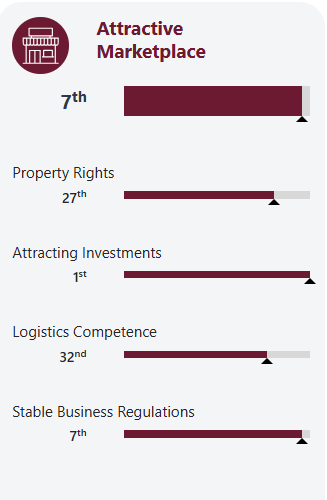
Bahrain ranks first in the attractive investments sub category under Attractive Marketplace
A deeper dive into CGGI data reveals uneven performance in government effectiveness across regions, as well as in measures of capabilities and outcomes. The report explains that, in the aftermath of the pandemic, most countries saw their overall CGGI scores ebb for two years before reaching a turning point in 2023.
The tide has since risen for the third straight year, with 61 per cent of countries improving in 2026 versus 60pc in 2025, 49pc in 2024, and a low of 31pc in 2023, according to the report.
However, the improvement remains uneven across regions.
Asia Pacific leads the rebound with 79pc of countries improving year‑on‑year in 2026, followed by Africa – the most challenged and lowest‑scoring region among the five – with 71pc, and Middle East, Central and West Asia with 69pc.
Europe and North America and Latin America and Caribbean trail the pack with 49pc and 47pc of countries improving, respectively.
Europe and North America also account for 21 of the 47 countries across the world whose CGGI scores either declined or were unchanged in 2026.
“The findings of CGGI’s 2026 edition offer cautious optimism at a time of heightened geopolitical and economic uncertainty amid global contagion from the US and Israel’s war with Iran and a fragmented world trade order,” said the joint editors of the report Amit Prakash and Thomas Colson.
“We thank our contributors for sharing their experiences and insights and hope that the findings of the CGGI will inform, and inspire leaders and practitioners around the world to remain focused on the all‑important task of building government capabilities during these challenging times.”
&uuid=(email))