

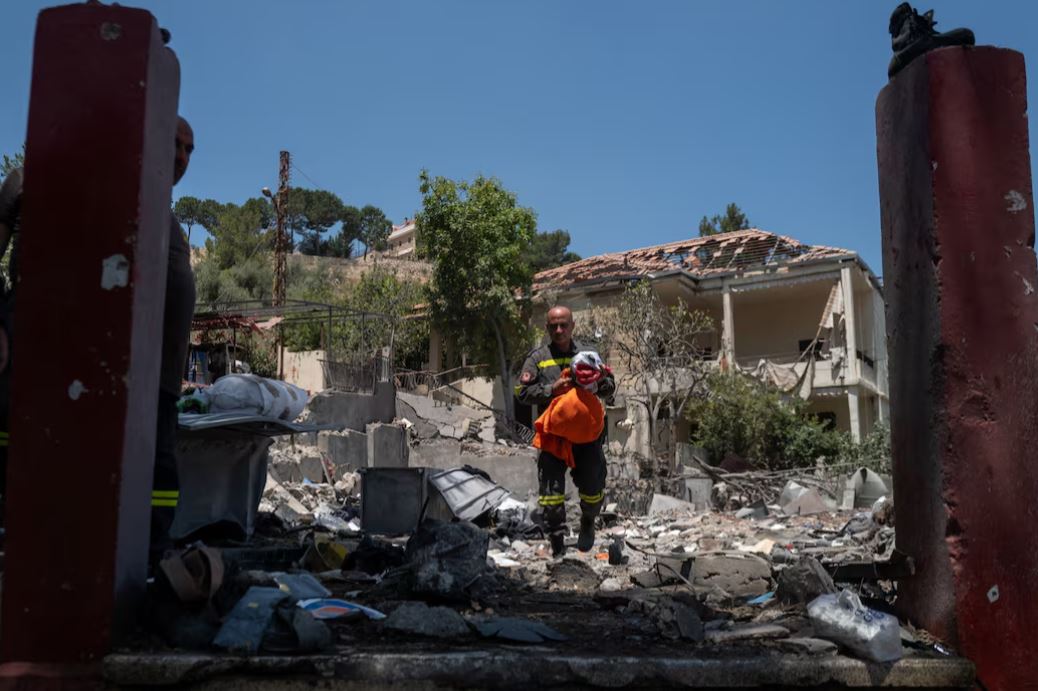
Rescue workers in the southern Lebanese city of Nabatieh said they believed their headquarters, clearly identified as a civil defence centre, would be safe from Israeli bombardment – until it was destroyed by an air strike last month.
Picking through the debris, they were salvaging whatever they could when Reuters visited this week.
“We used to spend more time at this centre than we did in our homes. We lost everything here,” said Hussein Daqdouq, dressed in grey civil defence overalls, as behind him men sifted through rubble. One pulled a fire extinguisher from the debris.
Nabatieh has been heavily bombarded by Israel during three months of war with Iran-backed Hizbollah. The city, a provincial capital and some 15km from the border with Israel, also suffered huge destruction in a war two years ago. The latest round of hostilities in Lebanon began on March 2, when Hizbollah opened fire at Israel in support of Tehran at the start of the US-Israeli war on Iran.
Nine members of the Nabatieh civil defence have been killed and another 15 wounded in this war, said Hussein Fakih, the regional head of the service. Two of them were killed in a drone strike in front of the centre on May 12, which prompted the civil defence to relocate away from the building.
The Israeli military claimed that Hizbollah operated from within medical facilities and used ambulances and medical vehicles to transport fighters and weapons.
Israeli strikes have killed nearly 4,000 people in Lebanon since March 2, including 746 women, children and healthcare workers, the Lebanese health ministry says.
Some 1.2 million people have been displaced, according to Lebanese authorities.
Khodr Kodeih, a member of the Nabatieh municipal council, said residents had begun trickling back this week, encouraged by an interim US-Iranian deal to end the regional war.
The agreement declares an immediate and permanent end to military operations on all fronts, including Lebanon. But renewed bombardment had led the city to empty out again, he said.
The scale of destruction in Nabatieh is even greater than in 2024, Kodeih added. “There may be more than 1,500 or 2,000 residential or commercial units affected,” he said.
Lebanon has yet to fully assess damage to the south, but the latest study by Lebanon’s National Council for Scientific Research found that more than 9,970 housing units had been destroyed or damaged in the Nabatieh area from March 2 to May 17 – the highest level of destruction of any district in Lebanon.
Israeli air strikes have pummelled towns surrounding Nabatieh since the Iran-US deal was announced, according to Lebanese state media and Lebanese security sources.
While Israeli troops had hit Nabatieh heavily in air strikes, they had not reached it with ground troops, a foreign security official and Lebanese security sources said.
The foreign security official said Israeli troops had been trying to effectively encircle Nabatieh but had encountered fierce resistance from Hizbollah fighters in surrounding villages and hilltops.
&uuid=(email))