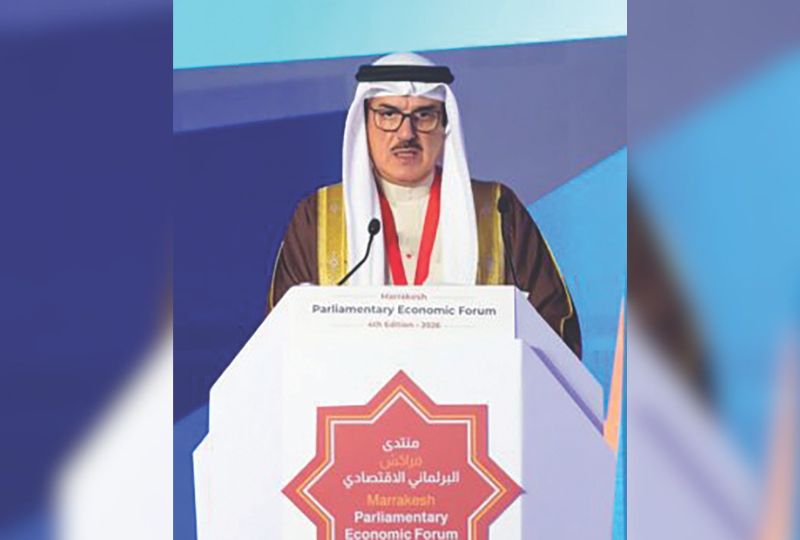
Parliament Speaker and chairman of the executive committee of the Parliamentary Division Ahmed Al Musallam highlighted Bahrain’s commitment to strengthening relations with Mediterranean and European countries in a manner that supports stability, development, and shared interests.
He noted that Bahrain recognises the close link between maritime security, economic stability and freedom of navigation, when he took part in the opening session of the fourth Marrakech Parliamentary Economic Forum for the Euro-Mediterranean and Gulf region, in Marrakech, Morocco, yesterday.
The forum, which concludes today, is organised by the Parliamentary Assembly of the Mediterranean and the House of Councillors of Morocco, in partnership with the Parliamentary Network on the World Bank and the International Monetary Fund.
Mr Al Musallam emphasised that Bahrain’s foreign policy, led by His Majesty King Hamad and supported by His Royal Highness Prince Salman bin Hamad Al Khalifa, Crown Prince and Prime Minister, is founded on the belief that lasting security and peace are achieved through constructive co-operation and effective partnerships.
Mr Al Musallam said economic and political affairs are closely interconnected and underscored the importance of strengthening regional co-operation and expanding Euro-Mediterranean and Gulf economic integration.
He said the security and stability of the Mediterranean Sea and the Strait of Hormuz are essential to economic growth, noting the importance of joint parliamentary action in addressing economic and security challenges.
Mr Al Musallam called for deeper economic co-operation between Euro-Mediterranean and Gulf countries, describing it as a necessity to address common challenges and enhance growth and prosperity opportunities.
He stressed the importance of joint projects in renewable energy, electricity interconnection, securing maritime routes, and protecting critical infrastructure, noting that economic strength is the true guarantee of political sovereignty.
He said discussions on the security of the Mediterranean and the global economy cannot overlook the risks facing the Strait of Hormuz in the Arabian Gulf.
Al Musallam said the current developments in the region, particularly as a result of the Iranian aggression, require renewed attention to supply chain security and energy routes.
He added that attacks on oil tankers, threats to maritime routes, and attempts to undermine stability in the Arabian Gulf represent not only a regional issue but also a direct threat to global economic security, increasing insurance costs and creating volatility in energy markets.