

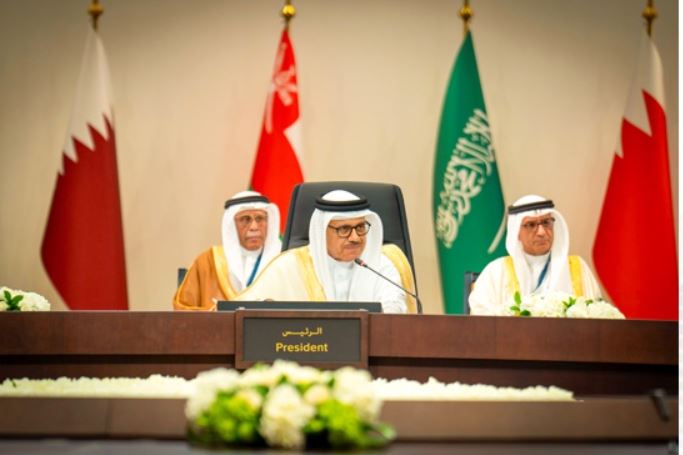
The Joint Ministerial Meeting between the Gulf Cooperation Council (GCC) member states and the United States was held with the participation of the foreign ministers of GCC member states and the United States.
The meeting was co-chaired by Dr. Abdullatif bin Rashid Al Zayani, Minister of Foreign Affairs, on behalf of the GCC, and Marco Rubio, United States Secretary of State, on behalf of the US.
Jasem Mohamed Albudaiwi, Secretary General of the Gulf Cooperation Council, attended the meeting.
Dr. Al Zayani conveyed the greetings and best wishes of His Majesty King Hamad bin Isa Al Khalifa and His Royal Highness Prince Salman bin Hamad Al Khalifa, the Crown Prince and Prime Minister, for the success of the meeting.
He noted that the region has undergone a critical period, with recent attacks on GCC states testing and revealing the true strength and resilience of our societies, institutions, and defense capabilities. While physical damage can be repaired, he said, the attacks also disrupted the sense of security and stability long enjoyed by the region’s people.
Dr. Al Zayani stressed that these events have strengthened the GCC’s determination to work with international partners to prevent similar incidents and to build a lasting foundation for peace, security, and stability for future generations.
He welcomed recent diplomatic efforts that led to a cessation of hostilities through the US–Iran Memorandum of Understanding, supported by mediation efforts by the Islamic Republic of Pakistan and the State of Qatar, as well as the restoration of safe navigation through the Strait of Hormuz. He also welcomed the Sultanate of Oman’s announcement of a temporary maritime corridor for vessels transiting the strait.
While describing these developments as encouraging, Dr. Al Zayani emphasised the importance of Iran fully honouring all commitments, including those under the memorandum. He added that sustainable regional security requires not only preventing Iran from acquiring nuclear weapons and safeguarding freedom of navigation, but also ending missile and drone attacks, halting support for militias, respecting the sovereignty of neighbouring states, and addressing the consequences of previous attacks in line with UN Security Council Resolution 2817.
He reaffirmed Bahrain’s strong strategic partnership with the US, supported by the Comprehensive Security Integration and Prosperity Agreement (C-SIPA), and expressed the Kingdom’s aspiration to further expand cooperation in security, economic development, and technology in support of regional stability and energy security.
Dr. Al Zayani also reiterated the GCC’s core principle that the security of its member states is indivisible, noting that any threat to one member constitutes a threat to the Council as a whole, in accordance with the GCC Joint Defence Agreement, which remains the cornerstone of our cooperation with partners, foremost among them the US.
Turning to regional priorities, Dr. Al Zayani underscored support for the unity, sovereignty, and stability of Syria, the preservation of Lebanon’s stability, and efforts to advance peace in Gaza through the Board of Peace with the aim of achieving a just and comprehensive peace.
He reaffirmed the GCC’s strategic commitment to peace and good neighbourly ties, expressing hope for a new chapter in the region based on respect for sovereignty, adherence to international law, and the protection of international waterways, in partnership with the United States.
For his part, Secretary Rubio highlighted the longstanding partnership between the GCC and the US. He said decades of cooperation have been guided by the shared objective of advancing regional and global security, stability, and prosperity.
Secretary Rubio described recent events as a significant test of the alliance, adding that the close coordination and cooperation demonstrated throughout the crisis underscored the strength of the partnership. He said his visit reflected appreciation for the support provided by GCC states and expressed hope that the region is entering a new phase that will lead to peace.
He stressed that the US seeks a Middle East focused on economic development and improving the lives of its people rather than conflict or weapons production. While acknowledging existing challenges, he said the US, together with GCC partners, intends to pursue constructive dialogue with Iran and hopes it will choose to prioritise the welfare of its people over exporting revolutionary ideology.
Secretary Rubio emphasised that while the US seeks an agreement, it will only support one that is credible, verifiable, and enduring. He highlighted that any commitments reached must be fully implemented and respected throughout and beyond the negotiation process.
Regarding the Strait of Hormuz, he stressed that international waterways must remain open and cannot be controlled or subject to fees by any single nation. He also reiterated that any agreement with Iran must ensure, through verifiable measures, that it does not acquire a nuclear weapon.
He added that the US is committed to ensuring that any agreement reached safeguards the interests and security of its Gulf partners and allies.
Secretary Rubio thanked the GCC countries for their longstanding ties and cooperation, reaffirming Washington’s commitment to a successful process and to an agreement that does not undermine the security, stability, or prosperity of any GCC state.
At the conclusion of the meeting, both sides reviewed regional developments and ongoing US-Iran negotiations aimed at securing a comprehensive peace agreement under the memorandum of understanding, ending military operations across all fronts, reopening the Strait of Hormuz to international navigation, and enhancing regional security and stability.
The ministers emphasised the importance of maintaining momentum and unity throughout the negotiations to achieve a durable end to hostilities and ensure that Iran does not develop or acquire a nuclear weapon in any form. They also welcomed the reopening of the Strait of Hormuz, reaffirming that free, unconditional, and unrestricted freedom of navigation remains essential to regional and international security.
The meeting also addressed developments in Syria, Lebanon, and Gaza.meeting was attended by Shaikh Abdullah bin Ali Al Khalifa, Director General of Bilateral Relations; Dr. Yousif Abdulkareem Bucheeri, Director General of Legal Affairs and Human Rights; Ambassador Saeed Abdulkhaleq Saeed, Chief of the Coordination and Follow-up Sector; Ambassador Nawar Abdullah Al Mutawa, Acting Chief of GCC Affairs; and Minister Plenipotentiary Salman Hassan Al Jalahma, Chief of the Americas Affairs Sector.
&uuid=(email))