

Thousands of Venezuelans were feared dead yesterday after two powerful earthquakes, including the country’s strongest in over a century, wreaked havoc in and around the capital Caracas, trapping people beneath the rubble of collapsed buildings and setting off powerful aftershocks.
Jorge Rodriguez, who heads Venezuela’s national assembly and is the brother of interim President Delcy Rodriguez, said at least 188 people were confirmed dead and 200 were trapped.
He said 1,520 people were injured and at least 250 buildings had been damaged or destroyed.
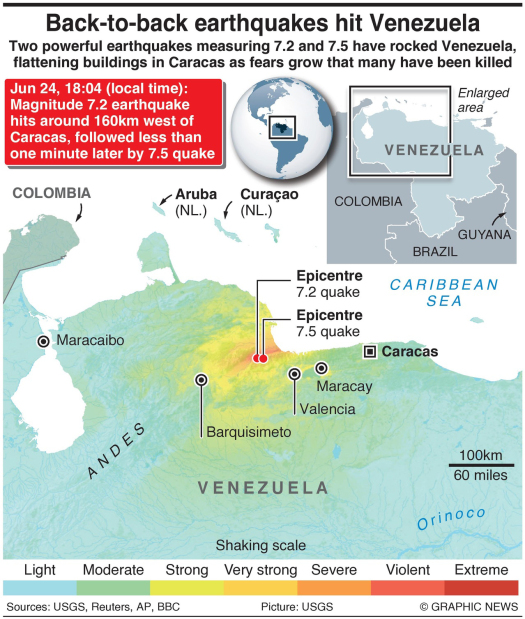
A magnitude 7.2 earthquake hit about 160km west of Caracas on Wednesday evening, followed less than a minute later by a magnitude 7.5 tremor, according to the US Geological Survey.
The disaster struck a country already grappling with years of economic turmoil that had left much of its infrastructure fragile, complicating rescue and recovery efforts.
In some areas, emergency workers scrambled over the debris of collapsed buildings through the evening.
In others, residents decried a lack of help.
The worst-affected area, La Guaira state, near Caracas, “has become a disaster zone,” President Rodriguez said, adding that her government was working with businesses to deploy heavy machinery to accelerate rescue efforts.
Rescue workers were scarce in the state’s coastal capital, also called La Guaira, where volunteers were digging with their bare hands.
Caracas’ main airport in La Guaira was closed yesterday after suffering damage.
Witnesses’ footage during the earthquakes showed scenes of panic as ceilings came down.
Many Venezuelans were at home when the quakes struck during a public holiday.
Residents fled shaking buildings and poured into the streets as structures collapsed across Caracas and nearby coastal areas.
“When we went downstairs, the scene was like a horror movie,” said Caracas resident Maria Alejandra, who did not give her surname.
Houses collapsed near the quake’s epicentre in Morón, a small seaside town in the state of Carabobo, where there was no water or electricity.
Three children were among at least eight killed in the area, municipal Mayor Emily Riera told Reuters.
The US Geological Survey, using predictive modelling to estimate the death toll, said it would most likely run into the thousands, with a substantial probability of exceeding 10,000.
A website set up to track missing people and shared by leaders from the country’s opposition, many of whom are outside Venezuela, listed more than 35,000 people as unaccounted for just after 1.30pm local time (1730 GMT). Reuters could not verify the veracity of every report.
The 7.5 magnitude quake was Venezuela’s strongest since 1900.
The country lies on the boundary between the Caribbean and South American plates and has suffered devastating earthquakes, including one that killed an estimated 30,000 people in 1812.
Maria Romero, an 80-year-old pensioner in southern Caracas, said police helped her out of her home.
“This earthquake was horrible, even worse than the one in 1967,” she said, referring to a magnitude 6.3 quake that the USGS said killed 240 people.
Leaders from across the political spectrum expressed solidarity with Venezuela, a notable shift from the international polarisation that has surrounded the country in recent years.
Rodriguez said international rescue teams were expected soon and thanked leaders including US President Donald Trump and Russian President Vladimir Putin.
Expatriate groups representing Venezuela’s diaspora, which numbers in the millions after years of mass migration, began organising aid collections abroad as relatives worked to contact family members back home.
Rodriguez called for unity in Venezuela, where anti-government protests over annual inflation of more than 500pc have become more frequent since Trump ordered the capture of President Nicolas Maduro in a violent raid in January.
Trump said the US was “ready, willing and able to help” and that the US would “be there for our new and great friends,” while US Secretary of State Marco Rubio said rescue teams were being deployed and the Pentagon would send assets to Caracas’ badly damaged airport.
Other cities and towns close to Caracas affected by the quake, including El Junquito and La Guaira, remained without power yesterday morning, increasing the challenges.
UN aid chief Tom Fletcher said the organisation was co-ordinating the rapid deployment of international rescue teams, adding that “a massive collective effort” would be needed in a country where even before the quake, 8 million people needed humanitarian aid.
The UN’s Venezuela human rights mission urged the government to lift restrictions on some social media, saying it was a “matter of life and death”.
Access became available in some areas of the country, where cell services are unreliable.
At Caracas’ Hospital de Clinicas, staff doubled up on the night shift to treat the injured, a worker said. School was cancelled for the rest of the week.
The city’s stock exchange was closed and will be used for rescue efforts.
&uuid=(email))