

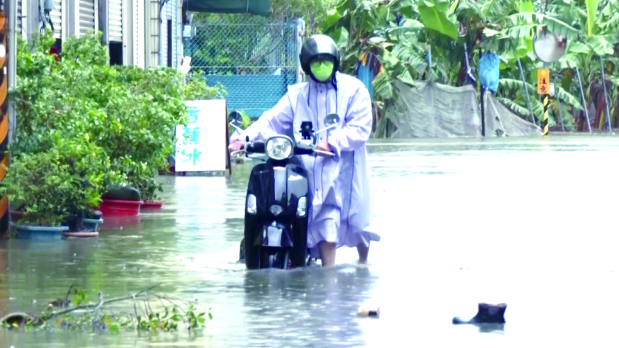
Japan grappled with transport disruptions yesterday while bracing for more torrential rain and risks from two approaching tropical storms that spurred authorities to issue high-level landslide warnings and order the evacuation of 1 million people.
More than 200 flights were cancelled and dozens of train services suspended while many expressways were closed, the land ministry said, while carmaker Toyota briefly halted operations at a factory in the southern region of Kyushu.
Weather officials said a lingering seasonal rain front combined with warm, moist air from tropical storms Mekkhala and Higos brought downpours to wide swathes of Japan’s west, threatening landslides, floods and swollen rivers.
About 1 million people faced evacuation orders after some were lifted in Okinawa and other southern areas, emergency management authorities said.
Mekkhala, downgraded from a typhoon to a tropical storm, was passing over the southern Ryukyu Islands yesterday after skirting Taiwan, where severe rains shut down parts of the island to keep about 6 million people from work or school.
“Last night the rain wasn’t too bad. But this morning the rain didn’t stop,” said Chi, a dessert shop owner in northern Taiwan’s Zhubei city.
Today, Mekkhala is expected to accelerate and approach western and eastern Japan, around the same time that Higos was forecast to draw close to the country’s east, and possibly make landfall, the Japan Meteorological Agency said.
The combined impact of the storms and the rain front could boost rainfall across much of the country, it added.
Taiwan ordered offices and schools closed yesterday in its three hardest-hit southern regions of Kaohsiung, Pingtung and Tainan, where severe flooding shut down a section of the island’s main north-south railway link.
No casualties were reported in Taiwan but authorities in Hualien county evacuated nearly 200 residents from two townships downstream of a rapidly filling barrier lake in the mountains.
Rain is not all bad news for southern Taiwan, which relies on the traditional summer and autumn typhoon season to fill its reservoirs after winters that are typically dry.
&uuid=(email))