

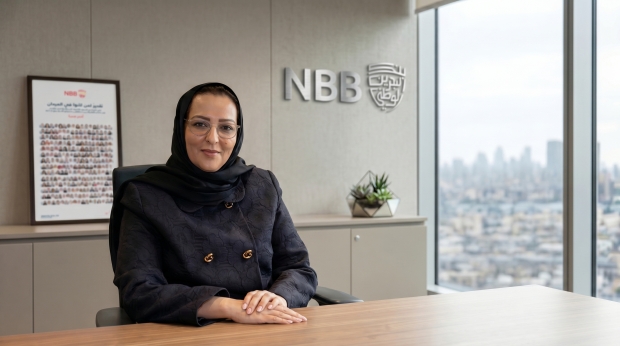
At an institution with the size and scale of the National Bank of Bahrain (NBB), the human resources function carries a multi-layered responsibility to ensure a positive experience for employees spread across multiple countries, while working within a regulatory environment that leaves little margin for inconsistency.
It also means accounting for a customer base that forms its perception of the bank by every interaction with its staff. Ms Hend Mohamed Mahmood has spent over three decades managing exactly that kind of complexity across the Kingdom’s financial services and government-linked sectors, before bringing that experience to NBB as its Group Chief Human Resources Officer.
“It is not just about the number of employees,” she says. “Banking is a highly complex and structured industry.” NBB’s workforce operates across branches throughout Bahrain, alongside Saudi Arabia and the UAE, in addition to the network run by Bahrain Islamic Bank (BisB). Co-ordinating that footprint, in her account, is less a matter of headcount and more a matter of architecture.
The structure behind the culture
Ms Mahmood’s description of how HR operates at NBB makes it clear that the department is considered as a strategic enabler rather than a support function sitting along the periphery of the business.
It leverages an integrated framework built to support the Bank’s strategy directly, with systems covering employee enrichment, performance management, career development, and promotions, all governed by clear methodologies and supported by technology.
“Rather than adopting a traditional HR approach, we focus on creating a strong organisational culture and fostering a mindset built on continuous learning and achievement,” she says.
For a bank operating across borders and regulatory regimes, consistency in how people are managed is what enables every employee throughout the Group working to the same standard.
Nurturing Bahrain’s banking talent
Bahrainisation levels at NBB exceed 95 per cent, a figure that cements the Bank’s commitment to national talent development.
That commitment also extends to aspiring professionals through structured graduate and student pathways. These include EVOLVE, the Bank’s flagship summer internship programme, Thrive, a six-month training that offers participating students full-time work experience, and a host of other collaborative projects centred on financial literacy, entrepreneurship, innovation, and sustainability.
Every initiative is structured to meet university accreditation requirements, while supporting the Bank’s future talent pipeline and contributing to the Kingdom’s broader efforts to empower and invest in youth development.
The scale is substantial. “In 2025 alone, we trained 240 Bahraini graduates,” Ms Mahmood says, work conducted in partnership with institutions including the Bahrain Institute of Banking and Finance (BIBF) and INJAZ Bahrain.
She is careful to frame this as more than a corporate social responsibility line item. “Our investment in human capital is a genuine and long-term commitment,” she says, pointing to the broader contribution these programmes make to Bahrain’s banking sector as a whole.
Future skills, present urgency
NBB’s succession planning process is reviewed annually and presented to the Board. It follows a formal structure put together to identify the Bank’s next generation of leaders well before the need becomes urgent. Ms Mahmood is candid about why the process looks further ahead than most banks’ planning cycles typically reach.
“Banking, in just a few years, will not be the same as it is today,” she says. “The direction is entirely digital. The focus is on fintech. The focus is on AI.” NBB’s leadership development programmes are developed around that trajectory, training capabilities it will need rather than ones it already has on hand.
She describes the skill set required of NBB’s leaders in two parts. The first is foundational: how a manager motivates, trains and fairly evaluates the people reporting to them.
The second is more future-focused, built around the technical and digital fluency the next decade of banking will demand.
HR’s role, in Ms Mahmood’s telling, is to arm managers with both, ensuring every leader across the Group operates to the same standard rather than according to individual instinct.
“You do not want inconsistent practices,” she says. “You want everyone to be aligned in how they manage and interact, so that people feel there is fairness and equality in how all leaders treat employees.”
A wider lens on inclusion
NBB’s Equal Opportunities Committee sits at the centre of how the Bank approaches diversity, drawing representatives from across departments and working in co-ordination with the national strategy of the Supreme Council for Women.
The Committee’s brief has expanded this year beyond its original internal focus, taking on a mandate to understand the needs of women in branches, the expectations of younger customers, and youth development more broadly.
The numbers behind this work speak for themselves. Women make up around 60pc of NBB’s branch workforce, a metric that Ms Mahmood attributes to recruitment practices that apply the same standards of merit, capability, and opportunity to all candidates.
“We believe that competence is the most important factor in selecting talent,” she highlights.
Where initiative gets rewarded
Ms Mahmood’s account of NBB’s learning culture moves past the conventional training calendar. Employees have access to classroom courses, workshops and on-demand online learning, alongside hands-on projects that engage them directly with the Bank’s operations.
The most distinctive element is the Group CEO Award, a quarterly recognition that honours employees driving impactful initiatives, including but limited to those focused on AI and process improvement.
The competition, Ms Mahmood remarks, has produced measurable change in how teams work, faster processes, and a genuine appetite among employees to improve their own ways of working.
Communication runs on a similar principle of structure paired with direct contact.
Ms Mahmood believes employee communication should flow primarily through managers, which is why leadership development includes equipping managers with the tools to support their teams properly.
But she does not rely on that channel alone. She conducts weekly branch visits alongside the Head of Branches, hearing concerns directly from staff before working with the Bank’s leadership to resolve them.
What loyalty looks like under pressure
When asked for a message to NBB’s employees, Ms Mahmood begins with gratitude. She points to the recent regional crisis, where staff were working from home under genuine uncertainty, as the most visible demonstration of what the Bank’s workforce continues to deliver.
The Bank’s priority during that period was to ensure critical services and branches remained accessible while safeguarding employees. When the situation began to stabilise, branch banking was restored fully in phases as conditions allowed.
“By the second week, we had already reopened our branches, and by the third week, all branches were fully operational, with employees present at their workplaces,” she recalls.
NBB’s employee engagement survey also echoed the same sentiment. The strongest factor behind staff loyalty was not compensation or career progression, but pride in working for the Bank.
“I genuinely share that same pride with them,” affirms Ms Mahmood. None of the strategic framework, the succession planning, or the graduate numbers is something a customer notices walking into a branch.
What they notice is whether the person serving them is glad to be there. That, more than anything else, is what NBB’s people strategy has been able to sustain and deliver.
&uuid=(email))