

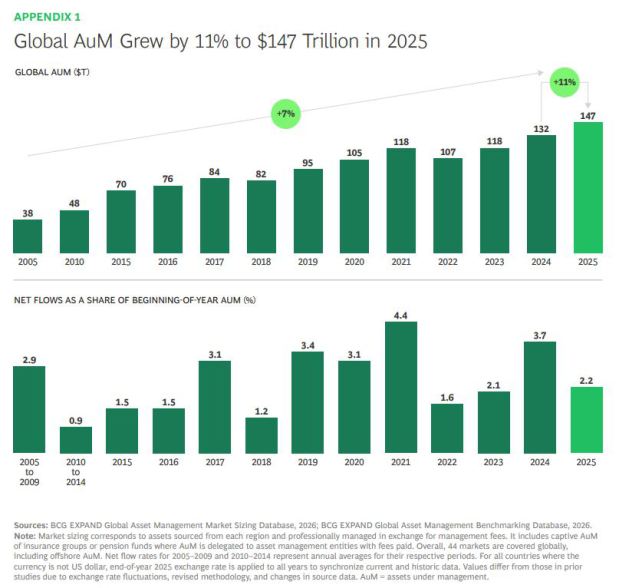
Assets under management (AuM) in the GCC surged by 10 per cent in 2025 to reach a historic $2.7 trillion, marking one of the region’s strongest annual performances in over a decade.
According to the ‘Global Asset Management Report 2026: An Imperative for Growth’ by Boston Consulting Group (BCG), regional growth was propelled by a booming retail segment, which expanded by 14pc.
Institutional assets grew by 9pc and continue to dominate the landscape, accounting for 93pc of total regional AuM, while retail assets comprise the remaining 7pc.
Saudi Arabia anchored this regional growth, commanding the highest share of retail mutual funds and ETFs across the Middle East and GCC.
The Saudi General Organisation for Social Insurance Public Pension Agency (GOSI-PPA) remains the region’s largest pension fund, followed by Kuwait’s WAFRA.
In the sovereign wealth fund sector, the Kuwait Investment Authority recorded the largest externally managed AuM, ahead of the Abu Dhabi Investment Authority.
On a global scale, the report noted a rebound in total AuM, which rose 12pc to a record $128trn. However, BCG highlighted an underlying vulnerability: 70pc of the industry’s $58 billion revenue growth was driven by market performance rather than new investor inflows.
Traditional active strategies faced $100bn in outflows globally, while passive funds absorbed $1.6trn in inflows. To counteract fee compression, global managers are pivoting toward fast-growing active ETFs – which grew at a 39pc compound annual growth rate (CAGR) over the last decade – and expanding retail access to private markets. Driven by retail demand, semi-liquid private asset funds have surged fivefold over the past four years to exceed $300bn in net asset value.
In terms of operational transformation, the implementation of artificial intelligence could reduce global asset management operating costs by 25pc to 35pc over the next three to five years. This integration is also projected to multiply research coverage up to five-fold and expand client coverage up to five-fold per relationship manager, allowing firms to scale efficiently.
Concurrently, tokenisation and digital assets are emerging as major forces that could reshape the global market structure. The value of tokenised real-world assets is projected to reach $14trn by 2030 and $55trn by 2035, opening entirely new channels for product distribution, ownership, and design.
BCG experts stressed that as market-driven growth gives way to competition-driven growth, regional firms must adapt quickly.
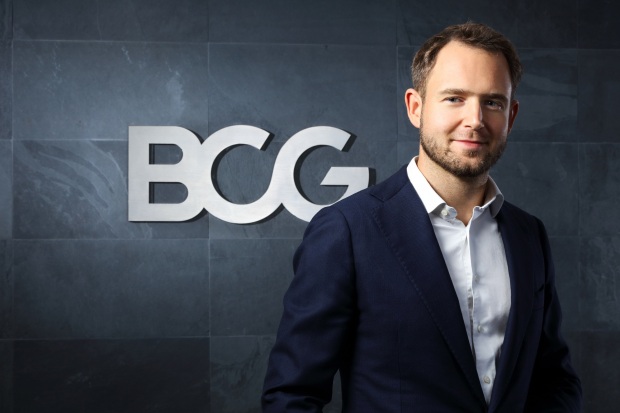
Mr Rey
“The GCC asset management industry is at an inflection point that demands a fundamentally different approach to competition,” said BCG managing director and partner and Middle East head of financial institutions Lukasz Rey. He noted that while near-term dynamics depend on the broader market, the region’s structural fundamentals remain compelling.
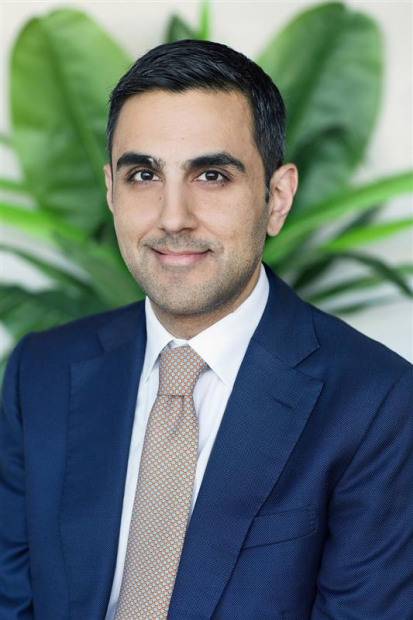
Mr Khan
Mohammad Khan, managing director and partner at BCG, added that Middle East asset managers have a unique opportunity to leapfrog traditional operating models by embedding AI and digital capabilities into their core operations to build scalable distribution networks.
Nabil Saadallah, managing director and partner at BCG, concluded that the convergence of tokenisation, AI, and evolving investor expectations will increasingly favour agility over incumbency, unlocking significant value for GCC managers who embrace personalised solutions at scale.
&uuid=(email))