

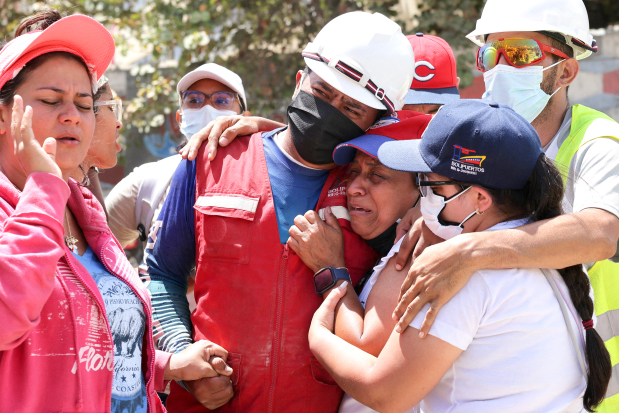
Frustration is rising across Venezuela over a lack of aid and co-ordinated government response in areas struck by deadly twin earthquakes last Wednesday, residents in some hard-hit towns said yesterday.
In El Junquito, a small mountainous region about 33km west of Caracas where Venezuelans often vacation on weekends, residents say they have seen few public officials, while farmers and other residents have been providing basic supplies to the community.
“We are waiting for answers, for debris to be cleaned up, for inspections, for people who have been really affected to be helped,” said Keily Ibarra, a 33-year-old manicurist leading citizen complaints to authorities. She called on the government to do “what needs to be done.”
El Junquito’s commercial centre was largely destroyed by the quakes, with collapsed buildings visible during a Reuters visit. Several residents with nowhere else to go have set up tents in an open field, despite the risk posed by damaged and collapsed buildings nearby.
“We don’t know where we are going to be located or how long we are going to be here,” said Tony Abreu, the owner of a local candy store who has been living in a tent since the quakes because his home and business are not safe.
Elsewhere, a hotel near Maiquetia Airport where more than 140 people deported from the United States, including seven children, were staying while being processed by Venezuelan authorities, collapsed in the quakes, according to two families of deportees. Most are believed to have been killed.
The government’s Return to the Homeland Grand Mission, which manages deportee processing, had shared videos online of the arrivals, including the children receiving toys.
While several international aid and rescue groups have mobilised to Venezuela, most of the help has been focused in La Guaira, the hardest-hit state of a country long mired in a deep political and economic crisis.
The international community has rallied to help Venezuela deal with the disaster. Authorities said the oil-rich South American country has received support from 30 nations, including 1,000 metric tons of supplies, more than 3,600 rescue and support workers as well as 118 search-and-rescue canines.
The death toll continued to rise. Jorge Rodriguez, the acting president’s brother and president of the National Assembly, yesterday put the number of confirmed dead at 1,719, with 5,034 injured and 15,866 left homeless.
Power outages yesterday have prevented a refinery, a petrochemical complex and other industrial plants in the country’s central region from restarting, industry sources said.
Despite those issues, state-run oil company PDVSA was not expecting any domestic fuel shortages as output from refineries in the country’s eastern and western regions is capable of meeting demand, even after increased usage by the rescue teams, they said. Oil output and exports remained normal, the sources said.
Caracas residents’ homes were rocked by an aftershock early yesterday, while rescue teams searched round-the-clock for a fifth day.
The 4.6-magnitude aftershock hit north of Caracas early yesterday at a depth of 10km, but Rodriguez said no damage was immediately reported.
&uuid=(email))