

Bahrain’s banking sector outperformed its regional peers in monthly credit growth and held the highest profit margins in the GCC during the first quarter of 2026, according to a new report analysing 55 listed regional lenders.
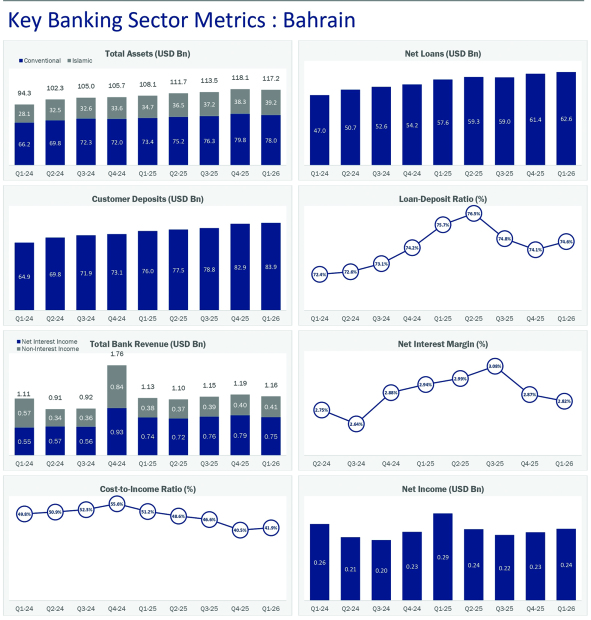
Kuwait-based Kamco Invest found that despite a highly volatile global macroeconomic environment driven by the Middle East war and resurgent global inflation, Bahrain posted the strongest monthly credit expansion in the region for April 2026, surging 1.43 per cent month-on-month to reach BD13.43 billion ($35.6bn).
The sector’s resilience comes amid a shifting global landscape where central banks, including the US Federal Reserve and the ECB, have enacted hawkish pivots or rate hikes to combat energy-led price spikes, delaying expected monetary easing.
Data from the first quarter of 2026 shows Bahrain’s total banking credit stood at BD13.24bn ($35.1bn) at end-March, expanding 5pc year-on-year. Lending growth was remarkably broad-based across the kingdom’s key economic pillars.
Education lending surged 60.5pc year-on-year to BD26 million, reflecting heavy investment in human capital, while manufacturing credit grew 24.5pc to BD509.9m, driven by the national industrialisation strategy.
Additionally, household credit expanded 21.5pc year-on-year, and financial and insurance activities increased 11.3pc to BD904.5m, reinforcing Bahrain’s position as a regional financial hub. Conversely, some sector-specific headwinds or project completions led to minor declines, with mining and quarrying contracting 15.6pc, construction dipping 8.2pc, and accommodation services falling 7.9pc.
While global interest rate volatility chipped away at net interest incomes across several markets, Bahraini banks maintained the highest net interest margins (NIM) in the entire GCC. Bahrain ranked first regionally, with margins staying above the key 3pc benchmark at 3.03pc for Q1-2026.
However, the rapid repricing of loans following regional rate adjustments in late 2025 took a slight toll on total top-line growth. Aggregate net interest income for listed Bahraini banks fell 5.2pc to $0.7bn during the quarter.
This decline mirrored a broader regional trend of cooling revenue growth, with GCC-wide sequential revenue growth slowing to a four-quarter low of 0.9pc.
At the regional level, total customer deposits across listed GCC banks hit a record high of $2.87 trillion, marking a solid 3.4pc quarterly growth. This influx of liquidity helped improve asset utilisation, with Bahrain and Oman tracking sequential improvements in their loan-to-deposit ratios.
Crucially, the report highlighted a massive seasonal relief in risk costs, with total loan impairments booked by GCC banks plunging by nearly a third to $2.7bn in Q1-2026 compared to the peak levels seen at the end of last year.
As global central banks signal a “higher-for-longer” interest rate reality for the remainder of 2026, Bahrain’s elevated profit margins and robust commercial credit appetite place its banking sector on a secure footing to weather further macroeconomic shocks.
avinash@gdnmedia.bh
&uuid=(email))