

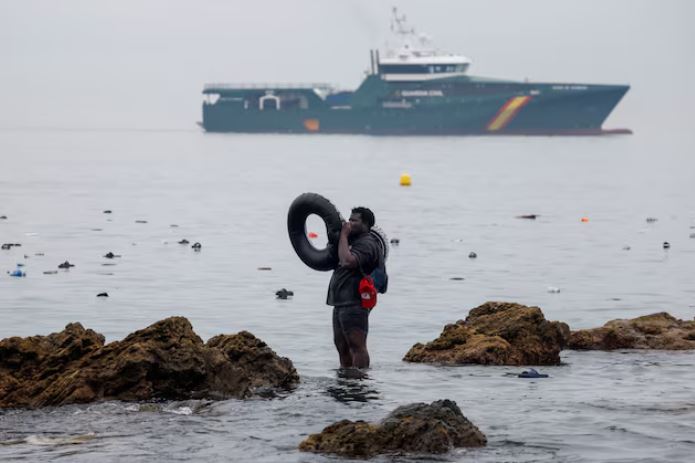
ITALY said yesterday it was suspending the European Union’s border-free Schengen arrangements with Spain for one month in response to a mass influx of migrants into the Spanish enclave of Ceuta from neighbouring Morocco.
However, the government said the measure would not affect Spanish or other EU citizens travelling to Italy and would instead involve targeted checks on non-EU nationals arriving from Spain by air or sea.
“This is an extraordinary measure, adopted to safeguard national security and prevent possible repercussions for our nation,” Prime Minister Giorgia Meloni wrote on X.
“The measure will be kept in force only for the time necessary, with particular attention to limiting any impact on summer tourist flows,” she added.
Italy, which does not share a land border with Spain, also said it had agreed with Paris to strengthen controls along the Franco-Italian frontier to try to prevent undocumented migrants from crossing.
The move came after Spain said it had largely reversed the rush of migrants into Ceuta, with most of the more than 50,000 people who had crossed into the enclave returning voluntarily to Morocco.
Critics of Meloni’s right-wing government dismissed the new border checks as largely symbolic, saying there was no indication that migrants arriving in Ceuta had any desire to travel onwards to Italy.
Meloni’s coalition, which came to power in 2022 promising to reduce illegal immigration, has faced strong pressure from a new far-right party led by former army general Roberto Vannacci, whose anti-migrant rhetoric has resonated with some voters.
With migration once again dominating headlines, the government has sought to promote a tough stance on security, however centre-left opponents accused the government of pandering to populists and undermining ties with Spain.
“The problem is that this is a purely demagogic proposal, as usual designed for domestic consumption and to compete with Vannacci, without solving anything at all,” said Piero De Luca, a senior lawmaker with the opposition Democratic Party.
The Schengen Area allows passport-free travel across 29 European countries, although member states can temporarily reintroduce border controls on security or public-order grounds.
Earlier, Moroccan forces beat back crowds with batons and tear gas at the gates to Ceuta, trying to prevent more from storming across into the tiny Spanish territory that juts on a spit of sandy land into the Mediterranean from Morocco.
Spain’s Interior Ministry said around 50,000 people had crossed the border since Thursday morning, and estimated that around 25,000 had already turned and gone back.
Juan Jesus Vivas, head of Ceuta’s local government, said as many as 60,000 people had pushed across and 34 had died. Earlier, Spanish authorities had said 19 bodies were found in the water.
The mass storm of the border caused division in Europe, where leaders of fellow EU states called for Spain to ensure that the incident was contained. Right-wing parties around the continent blamed the incident on Spain’s comparatively lax migration policies, including an amnesty granted to hundreds of thousands of unauthorised migrants this year.
France said it was increasing checks on its border with Spain, and Italy threatened to suspend Spain from the EU’s internal open-border scheme.
Reuters at the enclave’s border saw Moroccan police in riot gear using tear gas to disperse some of the people amassed near the fences. Water cannon trucks were deployed and the charred remains of a bus and seven cars could be seen from clashes with the crowds.
&uuid=(email))