

A first-of-its-kind breast imaging system has been unveiled in Bahrain by Royal Medical Services (RMS).
The advanced Gen3 device from Hologic is set to boost the accuracy and efficiency of breast surgery.
“The launch of the Gen 3 device reflects the keenness of RMS to keep pace with global developments in breast surgery techniques, and to provide advanced medical solutions that contribute to supporting treatment teams and enhancing the level of services provided to patients,” RMS commander Major General Shaikh Fahad bin Khalifa bin Salman Al Khalifa said in a statement yesterday.
The Gen3 platform is built around a wire-free and radiation-free surgical guidance system designed for advanced breast cancer localisation and staging.
The device relies on Magseed, which is a tiny magnetic stainless-steel marker, smaller than a grain of rice, used in breast cancer surgery to pinpoint with high accuracy the exact location of tumours or lymph nodes that are often imperceptible.
It also uses Magtrace technology to help identify the guard lymph node, while providing real-time guidance to the surgeon through sound signals and precise digital readings, supporting access to the target area during the surgical procedure.
Bahrain Oncology Centre chief executive officer Edward Roland noted that the Gen3 represents a qualitative addition in breast surgery, as it provides advanced capabilities that reduce dependence on traditional methods, such as the use of wires and radioactive materials.
This contributes to enhancing the comfort of patients and improving the efficiency of surgical procedures and the new system supports the surgical team in providing a more advanced treatment experience, in line with the latest international practices in this field.
According to the World Health Organisation’s International Agency for Research on Cancer, breast cancer accounts for 42 per cent of cancer cases amongst women in Bahrain and 20.6pc of cases across both genders, making it a leading concern amongst oncologists.
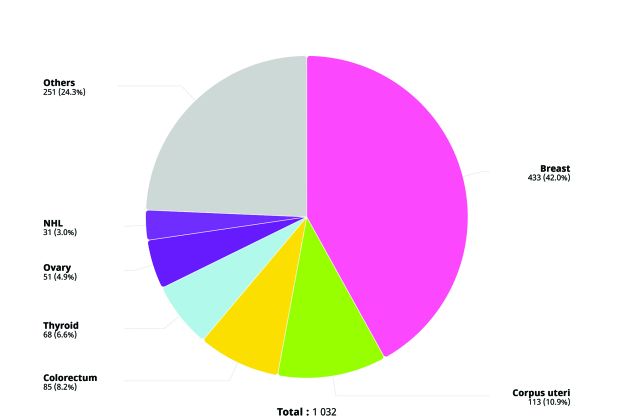
Incidence of different cancers amongst women in Bahrain in 2024
The GDN reported earlier this year on a study that found that the three most common cancers in Bahraini females are breast (58.5 per 100,000 people), followed by colorectal (12.4 per 100,000 people), and uterine (8.2 per 100,000 people) cancers,
The peer-reviewed study titled ‘Updated Key Determinants of Breast Cancer Risk in Bahrain: A Comprehensive Analysis’ found that the age category of females most likely to develop breast cancer was 46 to 55 years old, followed by 35 to 45 years old, more than 55 years old, and less than 35 years old.
RMS Women’s Health Centre president and Bahrain Oncology Centre general and reconstructive surgery consultant Dr Nouf Al Shaibani explained that the Gen3 device is an important development in breast surgery, as it helps the surgical team deal with cases with a higher level of accuracy and control, and improves planning for surgical procedures.
She stressed that this technology contributes to enhancing the experience of patients and supporting the achievement of better treatment outcomes through the combination of medical expertise and advanced technology.
&uuid=(email))