

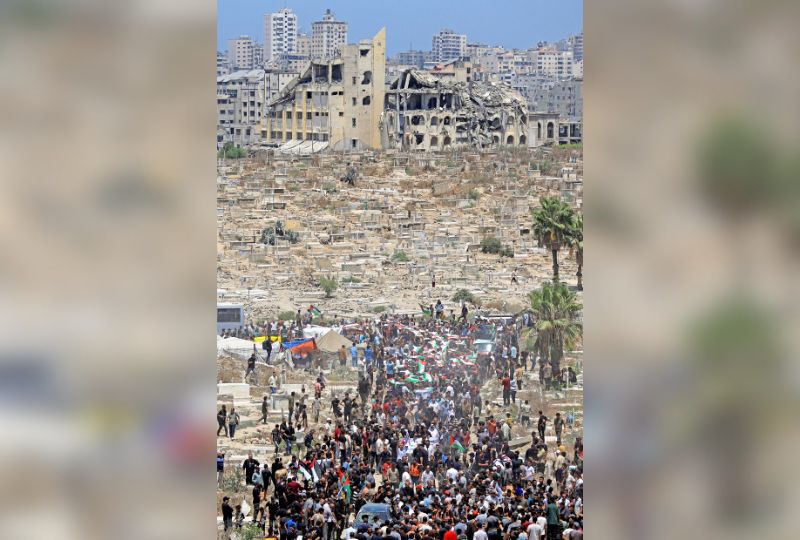
The decomposed remains of 112 bodies lay on stretchers shrouded in flags in the sun’s heat: all that could be found of the Al Hassaynas of Sabra, a Palestinian clan of proud Bedouin stock all but wiped out by Israel nearly three years ago.
According to Palestinian authorities, 308 members of the extended Al Hassayna family, also known as the Abu Sharia, were killed on November 22, 2023 when Israeli air strikes brought down a cluster of apartment buildings as residents slept in Sabra, one of the old neighbourhoods of Gaza City.
Around half of the dead were previously recovered and buried, but 153 bodies had remained under the rubble until now.
Nearly three years later, a recovery team of 40 workers spent 17 days painstakingly combing the wreckage, and brought out remains identified as belonging to 112 of those missing victims.
A cluster of neighbours and surviving members of the clan gathered yesterday on a flattened lot of demolished ruins, where the remains were laid out for what Palestinian authorities described as the largest mass funeral of the Gaza war.
Men lifted the stretchers and carried them through the streets. A sign was adorned with portraits of the dead – men, women and children.
“This day is mixed with grief, and it has reopened our wounds three years after this massacre,” said Taysir Al Hassayna, a surviving member of the clan.
“It has brought sorrow back to our children and women. But our consolation is that we believe they are martyrs with God.”
An October ceasefire that ended major fighting left Israeli forces in control of over half of Gaza, since expanded to around two-thirds. There, they have bulldozed remaining buildings and ordered people out.
The recovery of bodies can only take place in the remaining third of the territory, where nearly all of Gaza’s more than two million people now live, mostly displaced in makeshift tents or shelters in the damaged buildings.
Mahmoud Basal, spokesperson for Gaza’s Civil Defence, said identifying the remains of the Al Hassaynas required a mixture of forensic evidence and memories gathered from survivors.
“The bodies were decomposed. Relatives identified some through their clothes, injuries and distinguishing marks. Some victims had bone fixation plates on some organs, while some women were identified through jewellery they had on or necklaces bearing their names,” Basal said.
With this recovery operation now over, the team would move on to other accessible areas of Gaza.
“If we had at least 10 excavators, bulldozers, excavators, and cranes needed for the work, the job could be completed in three months,” he told Reuters.
When yesterday’s funeral procession reached a vast graveyard amid the ruins of Gaza, men passed the small shrouded bodies over their shoulders and laid the Hassayna clan to rest in fresh graves.
Reuters was unable to locate an Israeli military statement from November 2023 giving Israel’s account of the strike, which took place in the early weeks of the war launched after Hamas-led fighters stormed out of Gaza killing 1,200 Israelis.
&uuid=(email))