

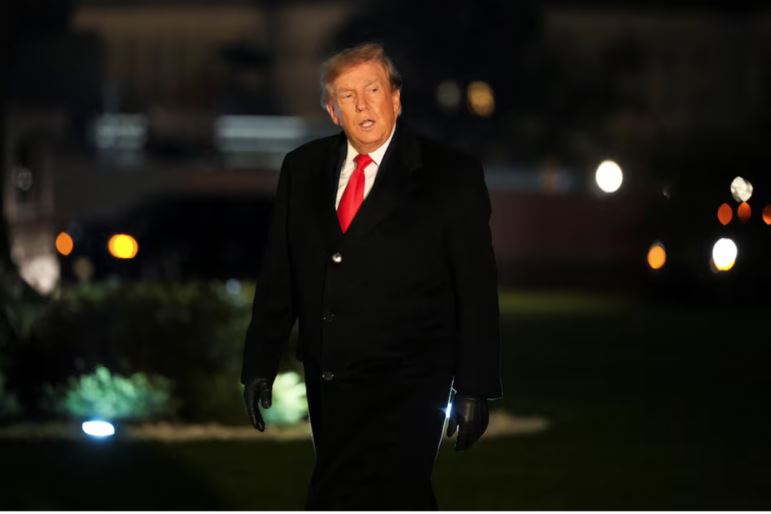
President Donald Trump said yesterday the Iran war has been worth it despite acknowledging its role in losses in US midterm elections in which his Republican party lost control of Congress.
“The Iran thing we had to do, and we continue to do it,” he told reporters.
The Iran war was responsible for a spike in fuel prices that were seen as a strong factor in why Democrats made big gains in the elections.
Trump said the war has been worth it to stop Tehran from ‘having a nuclear weapon.’
He said he was okay with Vice President JD Vance’s social media post in which Vance referred to deep electoral losses and said ‘the reason we lost is the war.’
“I can tell you that as far as that war is concerned, I would have done nothing different,” Trump said.
Trump also again said that if he had been on the ballot, he believed ‘we would have won.’
“But they just, you couldn’t transfer that love. There was such love at those rallies, it was incredible and we weren’t able to transfer the love to candidates,” he said.
Democrats vowed yesterday to use their resounding midterm victory to rein in President Trump, setting up two years of possible deadlock in Washington, as Trump spent his first post-election appearance showing off his under-construction White House ballroom.
A wave of anger over Trump’s policies, particularly the US-Iran war’s role in pushing the cost of living higher, helped Democrats take the Senate, where they flipped seats in deeply Republican states for a majority of at least 54-44, and the House of Representatives, where they gained at least 28 seats.
It will be the first time that Trump, a Republican who also held the White House from 2017 to 2021, has had to contend with a Democratic-controlled Congress.
House Democratic Leader Hakeem Jeffries said the incoming majority will be focused on affordability and accountability.
“We don’t work for Donald Trump,” Jeffries, a New York legislator who is on track to become the first Black speaker of the House, told reporters yesterday. “We work for the American people. And the days of the House of Representatives functioning like a wholly owned subsidiary of the Trump administration are over.”
Trump, who had devoted his last pre-election public appearance on Monday to talking about his renovations of the Lincoln Memorial Reflecting Pool, called in reporters on the morning after his party’s sweeping midterm defeat to show off the ballroom he is building at the White House.
“When I get criticised, like, ‘Why are you working on the White House?’ I’m doing it because the White House is the ultimate symbol of America, and it’s got to be pristine, it’s got to be perfect,” Trump said. “For me it’s relaxing.”
He turned only briefly to the elections during his nearly hour-long appearance, telling reporters: “I’ll get along probably with the Democrats, unless they want to be destructive, but I have the power of the veto.”
Trump had cast the midterm elections as a referendum on the first half of his second four-year stint in the White House, repeatedly urging his Republican base to ‘pretend I’m on the ballot,’ a message that Democratic Party leaders were happy to amplify.
The result: voters in conservative strongholds who had propelled the president to his second term in office just two years ago swung dramatically towards Democrats, due to deep frustration over the unpopular war with Iran, anxiety over the high cost of living and anger at Trump’s stewardship of the country.
In Texas, the biggest Republican-led state before Tuesday, Democrats ended a decades-long losing streak in seismic fashion, winning their first Senate seat there since 1988 and ousting three-term Governor Greg Abbott.
Kansas elected its first Democratic senator since the Great Depression nearly a century ago, and in South Carolina, a state that Trump carried by nearly 18 points in 2024, Democrats turned aside his hand-picked Senate candidate.
Over the past two years, the Trump administration’s sweeping policy shifts in the absence of opposition from a Republican-controlled Congress repeatedly buffeted global markets, from tariffs to the Iran war. Yesterday, as investors digested a historic Democratic sweep in US midterm elections, markets rallied.
The reason: a bet that gridlock in Washington would curb some of the worst-case outcomes in areas such as the Iran war, even though there were fresh worries, most notably about the backlash against AI infrastructure buildout.
