

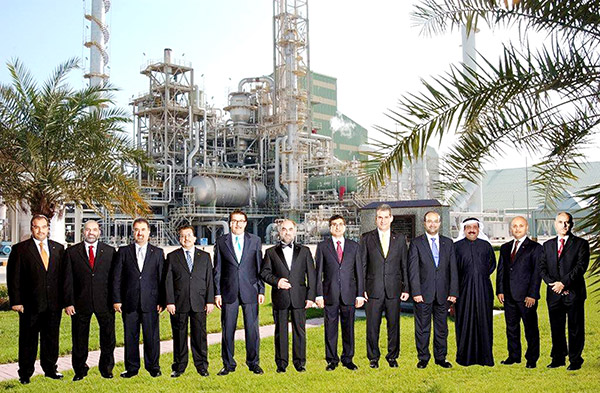

MANAMA: Bahrain-based Gulf Petrochemical Industries Company (GPIC) has posted a 2.25 per cent rise in net profit at $190.2 million for last year when compared with $186m for 2013.
The profit surge comes on the back of its highest combined annual production since inception.
GPIC, which is an equal stakes joint venture of Bahrain’s Oil and Gas Holding Company (nogaholding), Saudi Basic Industries Corporation (Sabic) and the Petrochemical Industries Company (PIC) of Kuwait, uses natural gas, available locally, as a basis for the production of ammonia, urea and methanol, which are its sole products.
The company said it produced a total of 1,600,528 tonne of ammonia, urea and methanol combined during the year.

Over the last year, working in cooperation with Sabic and PIC in the marketing of products and in operations, GPIC said it exported a total of 1,229,025 tonne of products via 66 ships.
Last year also saw the company post its highest-ever cumulative saleable production of ammonia, urea and methanol combined at 1,209,077 tonnes.

GPIC also set a new milestone of more than 18.7 million work hours without a lost time accident (LTA).
In a statement, the Prime Minister’s Adviser for Oil and Industrial Affairs and GPIC chairman Shaikh Isa bin Ali Al Khalifa said the company continued to grow at a steady pace and received significant recognition in Bahrain, the region and across the world.
“The year was one of diverse and outstanding achievements,” he said, the most notable being the new LTA record, in the making since May 2002.
Shaikh Isa said the company’s profits and other achievements reflected the “impressive performance and the safety and reliability of its factories on the one hand, and the efficiency of the executive management and employees on the other”.
The chairman said GPIC continued to give high priority to the development of human capital.
“We have consistently provided all our employees with the best possible working environment and have adopted a comprehensive plan designed to meet all functional expectations.
The company remains committed to continuous process improvement and development, aimed at excellence in all business processes, particularly management systems, he said.
Meanwhile, the Gulf Petrochemicals and Chemicals Association (GPCA) has forecast that as mega-projects for plastics and fertilisers come on-stream, petrochemical production capacity in the Arabian Gulf is expected to hit 198.6 million tonne by the end of this decade.
Capacity has grown nearly four-fold since 2000, to 147.2 million tonne last year.
“The GCC petrochemical industry has consistently exported around 80pc of its products in the last five years, counting the EU has a major market after Asia,” said GPCA secretary general Dr Abdulwahab Al Sadoun, during a roundtable discussion hosted by Federation of GCC Chambers in Riyadh earlier this month.
&uuid=(email))