

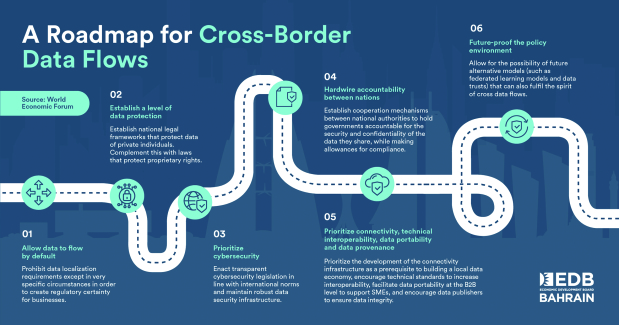
MANAMA: The Economic Development Board (EDB), Bahrain’s main investment promotion agency, has partnered with the World Economic Forum (WEF) to launch a new roadmap for cross-border data flows to help drive global tech-based collaboration.
The framework helps countries and regions embrace the Fourth Industrial Revolution at a time when restrictions on data movement pose serious threats to the global digital economy.
By following the recommendations set out in the roadmap, policymakers can build best-practice legislation and harness the economic and social benefits of data-reliant technologies such as artificial intelligence (AI) and blockchain.
The practical roadmap includes country-level policy building blocks designed to harness the benefits and minimise the risks of cross-border data sharing.
For some countries, such as Bahrain, small upgrades will be necessary as they have inspired the core principles by their own actions, whereas for others the framework may represent a full-suite starting point.
The kingdom has recommended countries form working groups to explore implementation.
Bahrain’s interest in the project stems from the recent introduction of national policy frameworks to facilitate data flow across borders and improve overall soft infrastructure, including the introduction of a data jurisdiction law allowing foreign governments to maintain their jurisdictions over data stored in Bahrain-based data centres.
The report was launched through a webinar featuring Transportation and Telecommunications Minister Kamal Ahmed and Information and eGovernment Authority (IGA) chief executive Mohammed Al Qaed as well as contributions from Everledger CEO Leanne Kemp and the national heads of the Centre for the Fourth Industrial Revolution for Colombia, Rwanda and Japan.
Speaking at the launch, Mr Ahmed said: “The free flow of data is critical for Bahrain and the wider GCC. Not only can it empower the region and enable it to compete in the Fourth Industrial Revolution (4IR), but the proliferation of new technologies enhances our competitiveness and ability to attract innovation.”
“I am very pleased that Bahrain has partnered with WEF and so many distinguished companies to push this issue up the agenda, and I hope that countries can come together to form a data-flow taskforce that steers our collective through the adoption of the recommendations within the roadmap.
“We are strongly committed to the new roadmap and want to lead the way to ensure that the entire region can prosper by balancing the risks and the rewards of the data economy.”
Data for the report was gathered from workshops around the world, including the annual meeting of the World Economic Forum in 2020, the Sustainable Development Impact Summit 2019, and the Summit on the Middle East and North Africa in 2019.
According to Mr Al Qaed, Bahrain has prepared its digital economy well, but data needs to flow across borders safely and seamlessly if the country is to retain its competitiveness, especially in the post-Covid era.
“As this report highlights, while the flow of information across borders has always accompanied the movement and trade of goods, the growth of Internet-based services and eCommerce, as well as 4IR technologies such as AI, the Internet of things and blockchain, are exceptionally reliant on accessing and processing high-quality data,” he said.
“It’s important to raise awareness of the benefits of cross-border data sharing and data privacy and security. Encouraging the open flow of business data through the right policies can help to end unnecessary escalations of operational costs and support innovative and collaborative business models.”
The IGA chief said he believes Bahrain’s current regulatory framework is future-proof and interoperable with many others around the world, as its building blocks are robust local privacy, cybersecurity and jurisdiction laws.
WEF Centre for the Fourth Industrial Revolution Network head and managing director Murat Sonmez is hopeful that “countries wishing to engage can feel confident in using the roadmap as a guide that balances the risks and benefits”.
The project was led by an expert working team including Sheila Warren, head of blockchain, digital assets and data policy and executive committee member at WEF; Anne Flanagan, project lead for data policy at WEF; and Nada Al Saeed, senior manager at the EDB.
Close collaboration with private enterprise was a key factor in the successful development of the roadmap, with a steering committee co-chaired by Baker McKenzie partner Lothar Determann and Ms Kemp.
avinash@gdn.com.bh
&uuid=(email))