

A HONEY-COATED micro-fibre mask could replace regular face masks and help solve a growing environmental waste concern, as well as limiting the spread of Covid-19.
Two Bahrain-based entrepreneurs have collaborated to create a biodegradable filtration system to protect wearers and offer a green solution as the world battles the pandemic.
The innovative concept is the brainchild of long-term Bahrain resident and bee lover Frank Ryde and Dr David Churches, a particulate science and capillary fluid flows expert.
“The current single-use disposable multi-layer surgical N95 face masks feature expensive plastic fibres and, as a result, they are uncomfortable to wear even for short periods,” said Dr Churches.
“They become seriously contaminated with infectious micro-organisms very quickly. On removal they are treated as infectious waste and, moreover, they aren’t biodegradable so are likely to persist in the environment – including the sea – for more than 400 years.
“Our Mel-Cotta (honey-coated) fabric uses completely organic locally-sourced materials and fabric derived from banana trees. The specialist active coating is derived from dried honey and propolis from bees.”
According to research, propolis is a compound produced by bees thought to fight infections and heal wounds and is believed to have antibacterial, antiviral, antifungal and anti-inflammatory properties.
Dr Churches highlighted that honey naturally exudes hydrogen peroxide, which can rapidly kill fungus, bacteria and viruses.

Dr Churches
“The Mel-cotta fabric is a very high efficiency passive filter medium designed to arrest and hold particulates around the 0.3 µm size and then kill and destroy infectious micro-organisms such as fungal-spores, bacteria and viruses – including Covid-19, with a specialist active coating derived from organic honey,” he added.
Researchers call this the most penetrating particle size. Scientists from Nasa have tested the particle capturing efficiency of filters and found that 0.3 microns is the lowest point.
The N95 surgical masks currently used in the fight against Covid-19 are worn in the millions every day across the world, with experts estimating that around 194 billion disposable masks and gloves are being worn worldwide every month.
Dr Churches revealed that the new fabric solution will be undergoing tests to measure material compositions and layer combinations to find the most effective for high-performance during both short and long-term use.
The testing will also include honey specialist formulations, as well as coating methodologies, to best maintain an adequate breathable air flow.
Mr Ryde has been an apitherapy therapist for 47 years and a champion of the branch of alternative medicine that uses honey bee products. He believes honey, especially Manuka Honey, has strong antiviral properties.
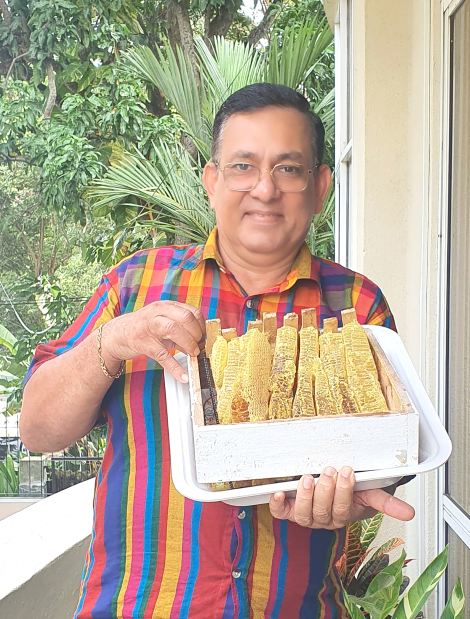
Mr Ryde
“Studies show that honey has properties against the varicella-zoster virus, the respiratory syncytial virus and also hand anti-influenza activity,” he said. “Honey has also been described as a source of healing in the Quran, along with black cumin seeds.
“Honey augmented with several additives – mainly dried spices such as turmeric and cumin – have successfully been used for centuries to improve the power of honey as early antibiotics and bactericides.”
He added that the main strategy would be to tap into existing supplies from Sri Lanka and production could provide jobs and revenue for a sustainable, prosperous future.
The filter will also be derived from banana stalks, cotton fibres and hemp as well as recycled paper, paper and fabric blends and paper molding for the face mask bodies, along with natural binders and adhesives made from local corn starch.
“The face mask seals will be derived from local natural rubber blends, including miling, curing and moulding,” he added. “Locally-produced honey and bee derivatives such as propolis, media coating and impregnation systems, as well as local spice seeds and prepared purified spices would add to the mix.
“The Mel-Cotta fabric is cost effective and very low priced. Coupled with medical approval and certification, this could likely become a world leader in its field.”
He highlighted that the same techniques could also be used to create filters for room air purifiers.
reem@gdn.com.bh
&uuid=(email))