

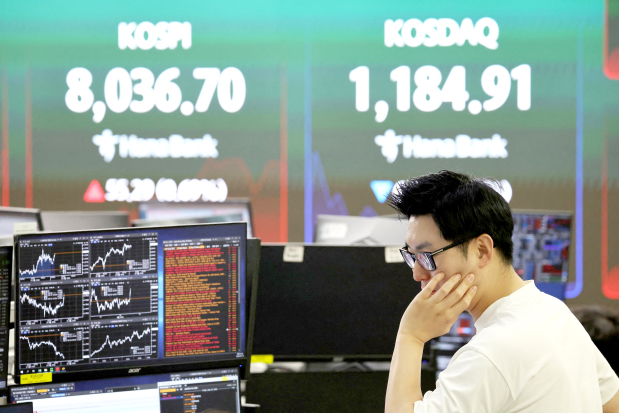
Global equity indexes fell yesterday while bond yields soared as investor euphoria over tech stocks gave way to inflation fears and traders increased their bets that the Federal Reserve will hike interest rates this year.
US President Donald Trump left China yesterday with no major breakthroughs on trade or tangible help from Beijing to end the Iran war. Uncertainty over a Middle East peace deal yesterday drove oil prices again, adding to concerns about inflationary pressures after two batches of high inflation readings for April earlier this week.
The S&P 500 and the Nasdaq sold off yesterday after climbing to closing records on strength in artificial intelligence-related technology stocks in the previous two sessions.
“There’s a realisation that the market had gotten way ahead of itself. It wasn’t paying enough attention to what the bond market and economic data was telling it. It was caught up in this momentum AI trade,” said Kenny Polcari, chief market strategist at Slatestone Wealth.
“The market is finally paying attention to what the bond market and the economic data is telling it. Inflation remains sticky and is potentially going to move higher in the months ahead.”
On Wall Street yesterday morning, the Dow Jones Industrial Average fell 432.76 points, or 0.86 per cent, to 49,630.70, the S&P 500 fell 75.90 points, or 1.01pc, to 7,425.34 and the Nasdaq Composite fell 387.22 points, or 1.45pc, to 26,249.36.
MSCI’s gauge of stocks across the globe fell 15.80 points, or 1.42pc, to 1,100.26.
The pan-European STOXX 600 index fell 1.56pc. Earlier, MSCI’s broadest index of Asia-Pacific shares outside Japan fell 2.54pc and Japan’s Nikkei slid 1.99pc after data showed wholesale inflation accelerated to 4.9pc in April, the fastest pace in three years, keeping the Bank of Japan on track to raise rates.
In South Korea the Kospi index fell more than 6pc yesterday after a run higher in recent months. It is still up 77.8pc year-to-date.
In government bonds, longer-dated US Treasury yields climbed to their highest levels in a year as elevated oil prices added to fears that ongoing energy disruptions in the Middle East could add to inflation. Concerns about inflation had already hit demand for US Treasuries. Demand was weak at auctions this week.
The yield on benchmark US 10-year notes rose 11.6 basis points to 4.576pc, from 4.459pc late on Thursday while the 30-year bond yield rose 10.1 basis points to 5.1137pc.
The 2-year note yield, which typically moves in step with interest rate expectations for the Federal Reserve, rose 8.3 basis points to 4.075pc, from 3.992pc late on Thursday.
In currencies, the dollar rose, placing it on track for its biggest weekly gain in more than two months, as the inflationary pressures drove bets on a Fed rate hike this year.
Traders were last betting on a roughly 38pc chance of a 25 basis point rate hike by year-end compared with a less than 14pc probability a week ago, according to CME Group’s FedWatch tool, which showed a 9.5pc chance rates would be 50 basis points higher by year end.
Yesterday was Jerome Powell’s last day as Fed Chair. The incoming Chair, Kevin Warsh, was nominated by Trump, who has pressured Powell to cut interest rates.
“The market is going test Kevin Warsh. They’re going to press him to see what he really stands for,” Polcari said.
The dollar index, which measures the US dollar against a basket of currencies including the yen and the euro, rose 0.32pc to 99.26, with the euro down 0.39pc at $1.1623.
Against the Japanese yen, the dollar strengthened 0.24pc to 158.73.
Sterling hit a five-week low in its fifth straight day of losses and was last down 0.43pc at $1.3341.
The pound had slid 0.9pc on Thursday following the resignation of health minister Wes Streeting, deepening Britain’s political crisis. Yesterday, British housing minister Steve Reed urged Labour Party lawmakers to get behind Prime Minister Keir Starmer, saying nobody positioning to replace him had shown enough support to launch a challenge.
In energy markets, US crude rose 3.7pc to $104.91 a barrel and Brent rose to $109.27 per barrel, up 3.34pc on the day. Among precious metals, gold fell to a more than one-week low under pressure from the rising dollar and Treasury yields as well as the bets for higher interest rates.
Spot gold fell 2.21pc to $4,546.93 an ounce. US gold futures fell 3.29pc to $4,524.30 an ounce.
&uuid=(email))