

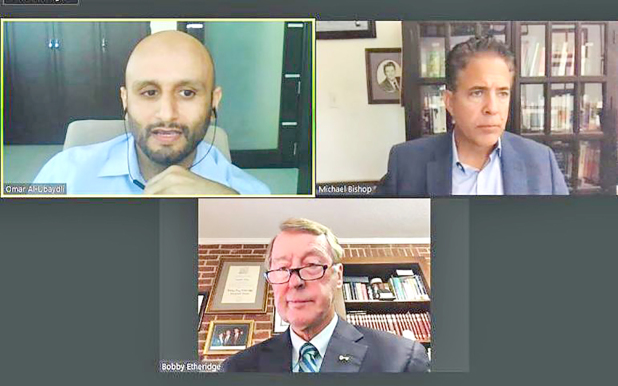
Think tanks in the West continue to be biased towards Gulf countries without portraying real developments on the ground, according to a former US Congressman.
Michael Bishop said in the social media age everything is drilled down to ‘140 words’ and comprehensive research on vital topics appears to be slowly fading away.
A think tank, or policy institute, is a research institute that performs research and advocacy concerning topics such as social policy, political strategy, economics, military, technology and culture.
“If you’re into public policy, you know that there are groups that are biased,” the former Congressman replied to the GDN during a webinar hosted by a Bahrain-based think tank.
“You have to weigh information from each entity, based on their credibility, believability, history and other factors that go into the idea of credibility. It’s hard to find an organisation that’s not biased.”
He believes the post Covid-19 world will create even more challenges for governments and think tanks, particularly at a time of diminishing amounts of funding.
The Bahrain Centre for Strategic, International and Energy Studies (Derasat) hosted the webinar titled ‘The role of think tanks in developing policy positions and priorities’.
It featured Mr Bishop and another former US Congressman Bobby Etheridge. The session was moderated by Derasat’s director of research and studies, Dr Omar Al Ubaydli.
Mr Bishop claimed that international thinks tanks failed to capture on the ground realities. “When you listen to any organisation you have to be prepared to apply your own experience and objective opinion.
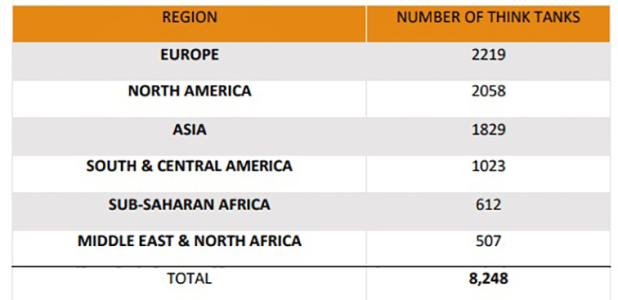
The Mena region has the lowest number of think tanks according to the Global Go To Think Tank Index
“I have no idea why the Gulf countries would have groups that would be biased against them ... there is a lot of history and politics there.
“We reduce everything into a 140-character soundbite, and that is the problem because we can’t provide information that is salient to the discussion.”
He further believes that social media has ‘distilled information to a small thought’ to grab the attention of readers and viewers and, as a result, a growing number of ‘biased posts’ continue to be spread.
Politics
Mr Etheridge also pointed out that with the growth of social media consumption a decline in the number of newspapers published in the US, for example, had followed.
“There has been a major contraction of active think tanks especially now during the pandemic, while roughly 1,800 weekly dailies or community newspapers in the US have shut down,” he added.
“We are going through a second wave of a technology revolution and we are struggling with it.”
Bahrain in the past decade has faced criticism from think tanks in the US and other countries that has had to be actively dealt with by counter narratives by government officials and local rights groups.
According to the latest Global Go To Think Tank Index (GGTTI) issued by the Think Tanks and Civil Societies Programme (TTCSP) at the University of Pennsylvania – Bahrain has 13 think tanks.
Overall the Middle East and North Africa has the lowest number (507) compared to other regions.
sandy@gdn.com.bh
&uuid=(email))