

MANAMA: Private markets are a key vehicle to capitalise on megatrends such as ageing populations, climate change and the redefinition of global trade, suggests Investcorp research.
The Bahrain-based alternative investment manager has issued a whitepaper titled ‘Increasing Allocation to Private Markets’, which reviews the trend of investors increasing their allocation of capital to private market investments such as private equity, private debt, real estate, absolute return, infrastructure and general partner stakes.
During a turbulent 2020, when traditional asset classes faced several challenges, such as historic lows in fixed income yields and a volatile equities market, capital continued to shift towards private markets.
Investor appetite has been influenced by factors such as active management approaches and longer investment horizons that offer the ability to navigate short-term pressures that can distort investment decisions in public markets.
Additional influencing factors include excess returns, diversification benefits, improved risk-return profiles and exposure to societal megatrends such as environmental, social, and (corporate) governance; and artificial intelligence, that underpin private markets.
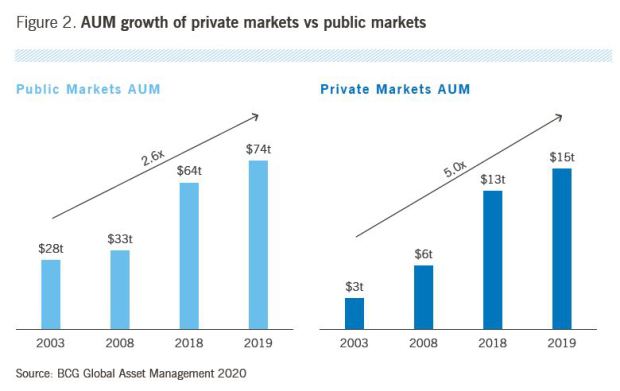
Capital flows into private markets asset classes has driven rapid assets under management (AUM) growth of private markets relative to public markets and the investor base has broadened to include institutional and private investors.
Managers in private markets have focused on product diversification and innovation; conventional fund products have expanded to include fund-of-fund products which allow investors to gain diversification across managers and secondary funds seeking to capitalise on limited partners’ desire to exit investments and in turn create a degree of liquidity for investors.
Richard Kramer, head of risk management at Investcorp, commented: “The resilience of private markets’ performance during the volatility and uncertainty that defined the past 18 months, supports robust investor allocations to these asset classes. However, constructing a portfolio of private market investments is just as great an opportunity as it is a challenge, and yielding a substantial return from the market requires careful consideration of the value proposition and prevailing macro environment.”
Investor fund flows into private markets asset classes, together with capital appreciation, has seen AUM in private markets asset classes grow at a rate of 11 per cent between 2003 and 2019, reaching $15 trillion in 2019, growing nearly twice as fast as public markets AUM which saw growth of 6pc over the same period.
Timothy Mattar, global head of distribution at Investcorp, said: “While private equity is a core product of private markets portfolios, we are seeing a strong demand for other alternative asset classes, including private debt and real estate. The rationale for allocation to private markets remains compelling, generating differentiated sources of return for investors. As private markets mature further, we expect to see product designs and structures evolve to cater to changing investor appetites and capitalise on new investment opportunities.”
Investcorp today has a presence in 12 countries across the US, Europe, GCC and Asia, including India, China and Singapore.
As of end-March 2021, the group had $35.4 billion in total AUM, including assets managed by third party managers, and employed approximately 430 people from 45 nationalities globally across its offices.
avinash@gdn.com.bh
&uuid=(email))