

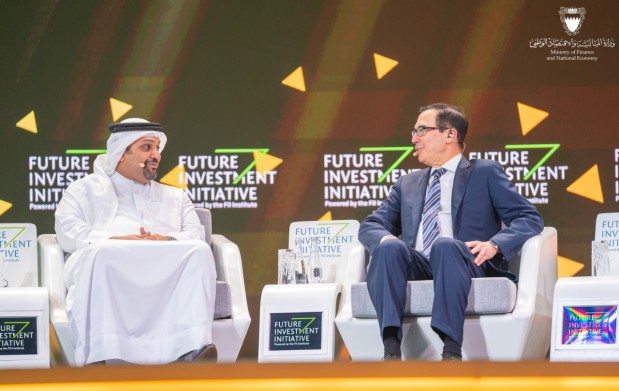
MANAMA: Bahrain’s priority right now is to use policy to turbo-charge economic growth after putting it on a sustainable path, the country’s Finance and National Economy Minister has said.
Speaking at the Future Investment Initiative Forum in Riyadh yesterday, Shaikh Salman bin Khalifa Al Khalifa told former US Treasury Secretary Steven Mnuchin during an interview that the initial focus of the government was on protecting society from the health impact of Covid-19 and the economy from the resulting economic impact.
Bahrain has fully vaccinated at least 90.3 per cent of the eligible population while 93.14pc have been given at least one dose.
Ranking
The country’s Covid-19 dynamics continue to improve, with one measure ranking it as second globally for its coronavirus response and recovery in September.
In Nikkei’s Covid-19 Recovery Index, Bahrain scored 72pc, only one point behind Malta, the top scorer, and ahead of the UAE (71pc) and Saudi Arabia (70.5pc).
The index ranks 121 countries and regions based on infection management, vaccine rollouts and social mobility, with a higher ranking indicating faster recovery.
“As the crisis unfolded,” said Shaikh Salman, “the government priorities in Bahrain were clearly defined. His Royal Highness Prince Salman bin Hamad Al Khalifa, Crown Prince and Prime Minister, made sure that as we make decisions and framed policy that we were seeing through the tunnel to see what would be its impact on the other side and that became very important to ensure the we were in the right frame to position us best as we come out of Covid-19.”
The minister admitted that the pandemic proved to be a challenge that was greater than anybody anticipated.
“I feel it takes a great crisis to galvanise the thinking, to spur innovation, to ensure we are positioning ourselves well for the future.”
Key steps taken by the government over the last 18 months include a $12 billion stimulus package designed to protect jobs and support business sectors affected by the health crisis.
These were instrumental in Bahrain’s economy growing 5.7pc in the second quarter of the year, following a contraction of 5.8pc in 2020.
Non-oil sectors grew 12.8pc during Q2 on the back of a recovery in the transport and hospitality sectors.
While the recovery has taken root, the finance minister now feels “one of the big risks in the upcoming period for global growth is inflation.”
He said shipping costs today are double what they were last year and energy costs in the US are up 25-50pc, while in Europe, natural gas prices are up seven-fold or more.
Inflation
“Inflation cannot be less than the sum of its parts and that will have its impact... One of the important aspects that has to be taken into consideration has been the unprecedented amount of liquidity unleashed into the system at the global level and once policy-makers start mopping up that liquidity there has to be a fine-balance,” explained Shaikh Salman.
“If you do it too slowly, inflation becomes a real risk based on the numbers we are seeing and if you do it too quickly there’s the risk of triggering a default cycle at a corporate or sovereign level. So one of the big things that we are watching now is how inflation and its components impact consumer prices.”
According to Shaikh Salman, one of the things that Bahrain has to contend with as energy prices, currently around $85 per barrel, increase is to ensure there are more revenue items that are positively correlated to economic growth.
“We launched the fiscal balance programme in 2018, with the aim of balancing the budget - revenue raising is only part of the picture as is cost-reduction, what it really aimed to do to correlate revenue to economic growth resulting in a positive change to the fiscal position.
Currently being discussed between the government and parliament, the planned doubling of value added tax to 10pc, is aimed at reducing Bahrain’s budget deficit and boosting state revenues.
“Economic stability has to do with ensuring that you are creating a poitive correlation to the non-oil GDP in the country. As oil prices go up that is great as it can drive capital investment cycles and provide long-term infrastructure on which you build,” the minister added.
Looking ahead, the minister said the real opportunity in “all our economies is that we are unleashing non-oil economic growth and its great to see the big strides that have happened.”
Shaikh Salman feels the next major transformational change will be how the economy generates, transmits and consumes energy.
“If you look at the technology revolution, it became transformational as we developed ways and means to generate, transmit and consume data. Similarly, energy is going to be the big thing 20 years from now, and it does take into consideration the climate change emergency that we have to address and the technologies in the field that are moving so rapidly.”
Another key driver, said the minister will be human intelligence.
“This has to go along with AI and therefore in this part of the world one of the most important aspects is the quality of the human resource that we find and we have seen global companies as well as many local start-ups really benefit from an ecosystem in which there is a well-educated, youthful labour force,” he concluded.
avinash@gdn.com.bh
&uuid=(email))