

I want to write of one of the most influential Christians of the Church of the East in the 7th century. Isaac is his name and he has many appellations. He has been called St Isaac the Syrian or Syrus, because he spoke Syriac, the language of the Church of the East, but he was not from Syria. Equally, he is called Isaac of Nineveh, as he was bishop of that city, near modern day Mosul in Iraq, but he stayed in office there only a few months, disillusioned by the life of a bishop! Finally, he has been called Isaac of Qatar, because he was born and lived, over half his life, in a region then known as ‘Beth Qatraye’.
It contained a much larger area than modern-day Qatar, and included Bahrain, Tarout Island, Al Khartoum, and Al Hasa. As such, this great holy man of the love of God has as much right to be owned by Bahrain as by Qatar. Indeed, his writings are infused with imagery that is all too well known to Bahrain. In fact, Isaac’s writings belong to humanity. Their stress on the magnanimity of the love and compassion of God reaches out to the modern spiritual seeker.
We know little of Isaac’s life. What we do know is that he was a monk. In 2019, archaeologists found evidence of a pre-Islamic Christian site in Samahij, Bahrain, probably the remains of a monastery or a bishop’s house. Ancient documents had already suggested the presence of Christian communities on the island. Names of towns and villages also suggested this presence in Bahrain between 4th and 7th centuries. For example, a village close to the archaeological site has the name ‘Deir’, which means monastery in Arabic. All tangential evidence that Isaac could have come from Bahrain.
In his writings, Isaac uses the images of the ocean, ships, pearl-diving, all resonant, if not exclusively so, to Bahrain.
If you lived in Bahrain in Isaac’s day the sea was your means of transport and communication, your world-wide web. It was a source of nutrition. It rendered the wealth of pearls.
For St Isaac, the ocean comes to represent the immensity of God’s inexhaustible love, his mystery and power. Like the ocean, God’s love can overwhelm us with its majesty: “How wonderful is the compassion of God – who can measure the ocean of God’s grace?” In one of his most famous sayings, St Isaac links the ocean, God and forgiveness: “As a handful of sand thrown into the ocean, so are sins of human flesh in comparison to God’s mercy.”
His prayer becomes: “O Ocean that has sustained the world, draw me out of the stormy sea.”
The sea can be an image of God’s majesty, mystery and grace, but equally of spiritual struggle.
In addition, Isaac uses the images of sailors and ships: “The sailor gazes at the stars as long as he is sailing on the ocean, and he directs his ship by them, that they may show him the harbour. The monk gazes at prayer, which directs his way, showing him towards which harbour he has to direct his course.”
The temptations of the world can cause the helmsman to lose his course. Isaac writes: “Glory on the part of worldly folk is like a rock hidden in the sea; it is not known by the sailor before his ship is split and sinks.” Beware!
In the Bahrain of Isaac, dolphins would have been numerous and so they too are employed to chart the spiritual life: “Just as the dolphin stirs and swims when the visible sea is still and calm, so also, when the heart is tranquil and still of wrath and anger, mysteries and divine revelations are stirred within her at all times to delight her.”
Isaac also uses the image of the journey from island to island to mark the stages of spiritual growth, knowledge and its end: “The mind that has found spiritual wisdom is like an equipped ship which, when he has got aboard, brings him from the ocean of this world to the island of the world to be.”
Bahrain, in its history, is renowned for its pearl divers, and Isaac also takes up this image. One has to be ready to dive into the depths, to be buffeted by the sea, to learn to hold one’s breath, and not to give up hope, for not every oyster yields a pearl. The same for the spiritual life, which is a dedicated seeking out of the Divine, in an ever-increasing openness to God in prayer, worship and service.
Just as a pearl is formed from grit in the oyster to become a jewel (not something Isaac would have known), likewise a person of dust and sin, can be transformed by grace into the image of God. For Isaac the pearl stands for the experience of divine grace or insight, which the person turned to God receives as pure gift. Just as looking at a pearl can inspire fascination, so does the treasuring of God’s gifts in our lives give rise to wonder.
What is the pearl of great price for Isaac? For St Isaac Jesus is the ultimate pearl, for others it will be the Prophet Muhammad. What Christ reveals, though, is the unfathomable compassion and mercy of God, which makes Isaac’s writings still so vibrant today:
“What is a merciful heart? It is a heart on fire for the whole of creation, for humanity, for the birds, for the animals … for all that exists. (…) one cannot bear to hear or to see any injury or slight sorrow in any in creation… because of the great compassion that burns without measure in a heart that is in the likeness of God.”
Bahrain has as much right to claim St Isaac as anywhere else along the coast of Northern Arabia.
His spiritual wisdom, though, is for all time and place.
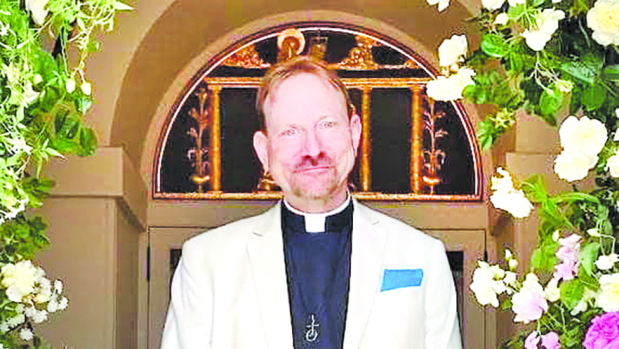
The Very Rev’d Dr Richard Fermer
Dean of St Christopher’s Cathedral
&uuid=(email))