

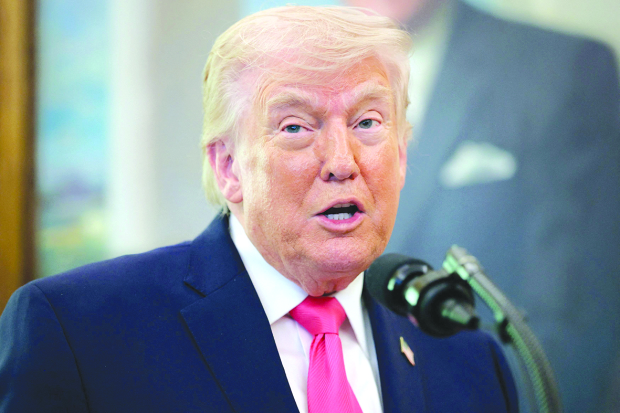
PRESIDENT Donald Trump’s approval rating fell in recent days to its lowest point since he returned to the White House, hit by a surge in fuel prices and widespread disapproval of the war he launched on Iran, a Reuters/Ipsos poll found.
The four-day poll, completed on Monday, showed 36 per cent of Americans approve of Trump’s job performance, down from 40pc in a Reuters/Ipsos poll conducted last week.
Americans’ views on Trump soured significantly with regard to his stewardship over the economy and the cost of living, as petrol prices have surged since the US and Israel launched co-ordinated strikes on Iran on February 28. Just 25pc of respondents approved of Trump’s handling of the cost of living, an issue that was at the centre of his 2024 presidential election campaign.
Only 29pc of the country approves of Trump’s economic stewardship, the lowest rating in either of Trump’s presidential administrations and lower than any economic approval rating of his predecessor, Democrat Joe Biden. Voters’ worries about the economy and specifically the rising cost of living were a significant factor in Biden’s loss and Trump campaigned on a promise to create a vibrant economy.
Analysts said the poll points to a president facing significant public opposition.
“It’s important that people know that the president feels their pain and that help is on the way,” said Amanda Makki, a Republican political strategist and lawyer.
Trump’s standing within his Republican Party remains mostly strong. Only about one in five Republicans said they disapprove of his overall performance in the White House, little changed from about one in seven last week. But the share of Republicans who disapprove of his handling of the cost of living rose to 34pc from 27pc last week.
Trump’s overall approval rating was 47pc in the first days of his presidency and since last summer had largely held around 40pc. It remains above his first administration’s low point of 33pc, and a touch higher than Biden’s low of 35pc.
The war in Iran could be changing that for a president who took office promising to avoid ‘stupid wars.’ The survey found 35pc of Americans approve of the US strikes on Iran, down from 37pc in a Reuters/Ipsos poll conducted last week. Some 61pc disapproved of the strikes, compared to 59pc last week.
Earlier Reuters/Ipsos surveys were conducted in the immediate aftermath of the first US and Israeli strikes, when many Americans were still learning about the situation, and respondents were given the option of saying they were unsure of their views.
A February 28–March 1 Reuters/Ipsos poll found 27pc approved of the strikes, 43pc disapproved and 29pc were unsure.
The most recent surveys don’t give the option of being unsure, though 5pc of respondents to the latest poll declined to answer the question on their view of the war.
Some 46pc of respondents said the war in Iran will make the US less safe in the long run, according to the latest poll. Only 26pc said it would make the country safer and the rest said it would not have much effect either way. While Trump in recent days has suggested the war could soon wind down, Iran has disputed Trump’s claims that negotiations were underway and Reuters reported on Tuesday that Washington is expected to send thousands of additional soldiers to the Middle East.
The average price of petrol in America has surged by about a dollar a gallon since the war started, as the conflict has severely curtailed oil shipments from the Middle East to the rest of the world. Experts warn that persistently higher fuel prices will eventually hit the wider economy.
Already, some 63pc of Americans consider the US economy to be ‘somewhat weak’ or ‘very weak,’ the poll found. That included 40pc of Republicans, 66pc of independents and 84pc of Democrats.
“This provides a huge opportunity for Democrats to make major strides in the midterms by focusing on issues that are traditionally more Republican issues, like national security, the economy and immigration,” said Doug Farrar, a Democratic strategist.
&uuid=(email))