

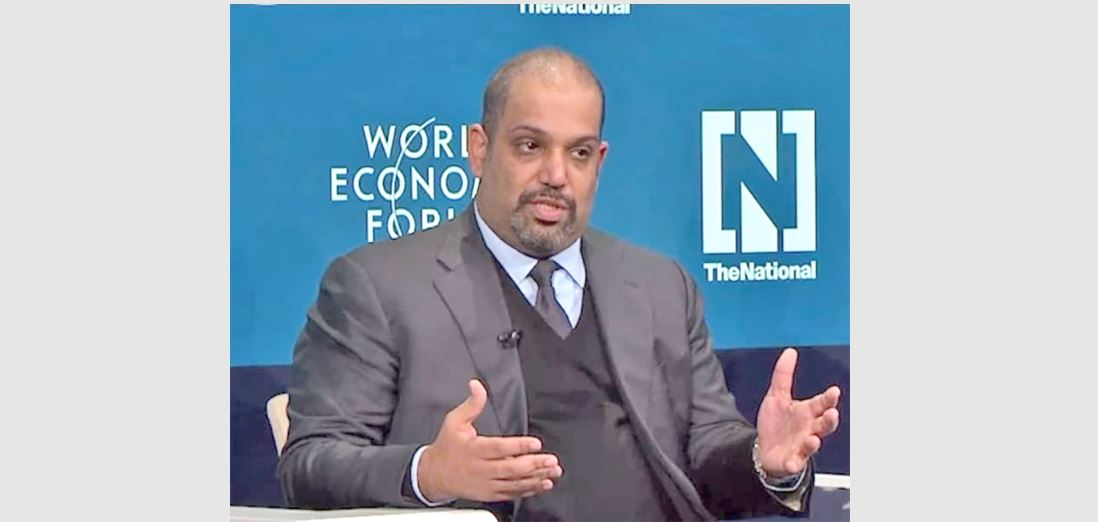
The six GCC nations are not competitors, but rather partners in progress, Finance and National Economy Minister Shaikh Salman bin Khalifa Al Khalifa told an audience of business leaders, policymakers, and NGOs at the World Economic Forum in Davos.
“The economic pie is growing so fast that competition is not even a concern,” he asserted during a panel discussion titled ‘Gulf Economies: All In’. “Each country is focused on developing its own service sectors, expanding its participation in the regional economy, and growing its GDP. There are significant synergies to be gained from this collaboration.”
Painting a promising picture for the region, Shaikh Salman cited tourism as a prime example, highlighting joint marketing initiatives that benefit the entire region.
“These efforts attract tourists not just to individual countries, but to the GCC as a whole,” he explained.
The minister also stressed the importance of sound policy and efficient execution in driving the GCC region’s robust economic growth.
“The GCC’s GDP is currently $2.3 trillion annually, and we’re projected to reach $3trn by 2030 and a staggering $6trn by 2050,” he stated. “This growth is driven by sound policies, efficient execution, and a focus on streamlining business processes and ensuring swift decision-making.”
“We’re simplifying regulations, making it easier to do business,” he elaborated.
Outlining the kingdom’s economic plans and ambitions, Shaikh Salman said Bahrain aims to position itself as a service centre for the wider GCC economic growth, driven by Saudi Arabia and the UAE.
Bahrain’s economic recovery plan, launched in October 2021, focusses on six key sectors: banking, telecoms, manufacturing, logistics, oil and gas, and tourism.
Long-running diversification efforts have taken the non-oil sector’s contribution to the national GDP to 83 per cent, with banking and finance being the largest contributor, the minister highlighted.
Responding to a question, Shaikh Salman said a growing young population with high levels of education and digital literacy further fuels regional potential.
The adoption of artificial intelligence (AI) across various industries is expected to be the most significant transformation since the industrial revolution, he asserted that Bahrain aims to become a hub for AI expertise and adaptation to remain competitive.
Also speaking on the panel was Majid Jafar, chief executive of Crescent Petroleum, who said the GCC economies are experiencing a golden age of growth and development supported by a positive cycle of reform, higher oil revenues, and falling interest rates.
Long-term infrastructure development and investment programmes, coupled with crucial reforms across all economic sectors, have created fertile ground for healthy, sustainable growth that is being accelerated by improving economic conditions, with regional GDP growth expected to be close to 4pc in the coming years.
“This is a golden age for the GCC as the region’s stability, infrastructure building, and investment flows boost its global influence and its economy just as a new generation of well-educated, ambitious young people enters the workforce, promising to continue on this path,” Jafar told the audience. “We are enjoying the fruits of visionary leadership and decades of stability in the region,” he added.
Moderated by The National’s editor-in-chief, Mina Al Oraibi, the panel discussion also featured Abu Dhabi Department of Economic Development chairman Ahmed Jassim Al Zaabi, Saudi Arabia’s Investment Minister Khalid Al Falih, Qatar’s Finance Minister Ali Ahmed Al Kuwari and Agility chairwoman Henadi Al Saleh.
avinash@gdnmedia.bh
&uuid=(email))