

GCC economies could jumpstart their growth by focusing on the weakest link in their productivity adding a whopping $2.5 trillion to their GDP over the next 10 years.
Outlining a new way of measuring productivity, a report titled ‘In Search of Productivity: The Next $50 Trillion In the Global Economy’, says by tackling this single biggest hurdle, the six-nation bloc could push GDP growth from 3.8 per cent to a booming 5.4pc by 2034.
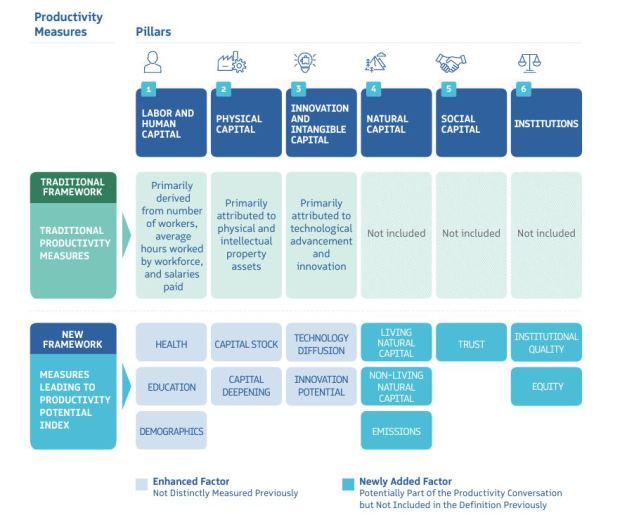
Released in Dubai by the World Governments Summit 2024 in partnership with Strategy& Middle East, the report’s Productivity Potential Index consists of 19 variables grouped into six pillars.
By adding pillars for social capital, natural capital, and institutions to the inputs of labour and human capital, physical capital, and innovation and intangible capital that make up traditional measures of total factor productivity (TFP), the index seeks to gauge economic growth that is “not only robust but also green, equitable, and socially responsible”, the report says.
A key insight is that while traditional factors like skilled workers, infrastructure, and machinery (human and physical capital) still drive progress, invisible assets are gaining power.
Strong institutions, cutting-edge research, and a culture of innovation are becoming top predictors of success, and measuring them is crucial. This is where the new Productivity Potential Index (PPI) comes in, filling the gap left by traditional economic statistics.
It also underlines that there are different drivers for different economies. In developing nations, building infrastructure, improving health, and strengthening institutions alongside Internet access are key.
In the Gulf Cooperation Council countries, chief predictors include human capital (including physical health and education) and natural capital (including water stress, natural resources, and air pollution).
The PPI captures these nuances, offering a customised roadmap for each country and suggests that GCC countries have a significant opportunity to boost their economies by focusing on improving their productivity using the new framework.
The new index also aligns perfectly with the ‘Beyond GDP’ movement, championed by the UN. It recognises that economic success goes beyond just numbers, accounting for factors like environmental sustainability and social well-being. By focusing on these ‘hidden engines,’ the PPI helps nations achieve growth that’s not just productive, but also responsible and inclusive, contributing to the UN’s Sustainable Development Goals.
Calling on each country to address their weakest productivity determinant and match it to the best-in-class among the sample, the report estimates that real GDP growth can accelerate from 2.6pc to 3.5pc.
This acceleration can yield an additional $50trn in global GDP in 10 years.
avinash@gdnmedia.bh
&uuid=(email))