

The first phase of the Israel-Hamas truce drew to a close yesterday, but negotiations on the next stage, which should secure a permanent ceasefire, have so far been inconclusive.
The ceasefire took effect on January 19 after more than 15 months of war sparked by Hamas’s October 7, 2023 attack on Israel.
Over the initial six-week phase, Gaza fighters freed 25 living hostages and returned the bodies of eight others to Israel, in exchange for hundreds of Palestinian prisoners held in Israeli jails.
A second phase of the fragile truce was supposed to secure the release of dozens of hostages still in Gaza and pave the way for a more permanent end to the war.
Israeli Prime Minister Benjamin Netanyahu had sent a delegation to Cairo, and mediator Egypt said “intensive talks” on the second phase had begun with the presence of delegations from Israel as well as fellow mediators Qatar and the US.
But there was no sign of consensus yesterday, and Hamas spokesman Hazem Qassem said the group rejected “the extension of the first phase in the formulation proposed by the occupation (Israel).”
He called on mediators “to oblige the occupation to abide by the agreement in its various stages.”
Max Rodenbeck, of the International Crisis Group think tank, said the second phase cannot be expected to start immediately.
“But I think the ceasefire probably won’t collapse also,” he said.
The preferred Israeli scenario is to free more hostages under an extension of the first phase, rather than a second phase, Defence Minister Israel Katz said.
A Palestinian source said Israel had proposed to extend the first phase in successive one-week intervals with a view to conducting hostage-prisoner swaps each week, adding that Hamas had rejected the plan.
Of the 251 hostages seized during Hamas’s attack, 58 are still held in Gaza, including 34 the Israeli military says are dead.
Hamas has pushed hard for phase two to begin, after it suffered staggering losses in the devastating war.
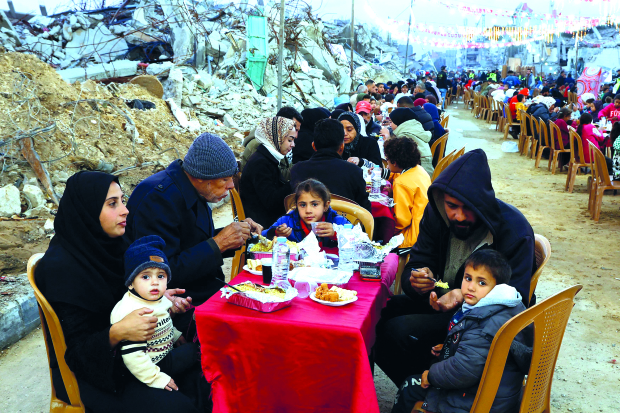
In Gaza and throughout much of the Muslim world, yesterday also marked the first day of the month of Ramadan.
Among the rubble of Gaza’s war-wrecked neighbourhoods, traditional Ramadan lanterns hung and people performed nightly prayers on the eve of the holy month.
&uuid=(email))