

Bahraini women have gone beyond the glass ceiling in increasing numbers with a high percentage of them working in both public and private sectors, according to the latest data.
Updated statistics by the Supreme Council for Women (SCW) gives a clear breakdown of sectors and institutions where Bahraini women have made their mark, with some heading top positions.
Data on political participation shows that 25 per cent of Bahraini women are in the Shura Council, 20pc in Parliament, 10pc in municipal councils and 40pc in the Capital Municipality.
The number of female ministers in the government represents 22pc, while participation in the public sector reached 60pc and the percentage of those in executive positions reached 50pc.
In addition, in the government sector, 64pc of women hold specialised positions.
Comparatively, Bahraini women’s participation in the private sector reached 36pc and those in executive positions is 36pc.
“The kingdom of Bahrain has taken pioneering steps in the field of women’s empowerment and advancement, developing women’s capabilities and supporting them to increase their participation in comprehensive national development,” said the SCW report based on 2024 data.
Figures further show that 66pc of Bahraini women are physicians, while a staggering 83pc are working as nurses, 37pc are women engineers employed in the public sector, and 57pc are academics in higher educational institutions.
The number of Bahraini women judges represents 14pc, while women lawyers reached 57pc, according to the SCW data sourced from different ministries and entities.
“The statistical data provide a clear view of the reality of Bahraini women in various sectors,” says the report.
“These statistics show the remarkable development in the sustainability of women’s ability to be worthy partners in nation building.”
Last month, the SCW held a co-ordination meeting with representatives from ministries and official institutions to present the 2025-2026 National Plan for the Advancement of Bahraini Women.
SCW secretary-general Lulwa Al Awadhi outlined the structure and priorities of the new plan, which brings together initiatives that remain pending from previous phases, alongside programmes aligned with the current Government Action Plan.
The 2025-2026 plan focuses on four main areas: Family stability, decision-making and leadership, economic inclusion, and overall quality of life.
These pillars reflect a comprehensive and integrated approach to supporting women’s roles in society and the economy.
The plan also introduces a forward-looking approach focused on emerging sectors, such as science, technology and innovation, and positions Bahraini women to take on greater roles at the regional and international levels.
The plan is shaped by key national directives, including the royal order establishing the SCW and its affiliation with the leadership, as well as Bahrain’s broader development visions, such as Economic Vision 2030, the Government Programme 2023-2026, and future planning frameworks extending through 2050.
The GDN reported previously that Bahrain moved up 12 places in a global index that benchmarks gender parity across 148 economies.
The 19th edition of the Global Gender Gap Index by the World Economic Forum covered countries based on four key parameters – Economic Participation and Opportunity, Educational Attainment, Health and Survival, and Political Empowerment.
Bahrain is ranked 104 in the world and second among the GCC nations. In the Gulf, the UAE takes the top spot at 69, followed by Bahrain (104), Kuwait (128), Saudi Arabia (132) and Oman (134).
The kingdom was ranked 116 in the Global Gender Gap Index 2024, 113 in 2023 and 131 in 2022.
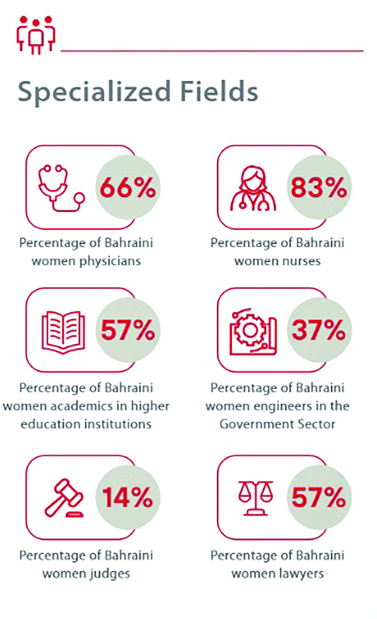
Percentage of Bahraini women working in specialised fields
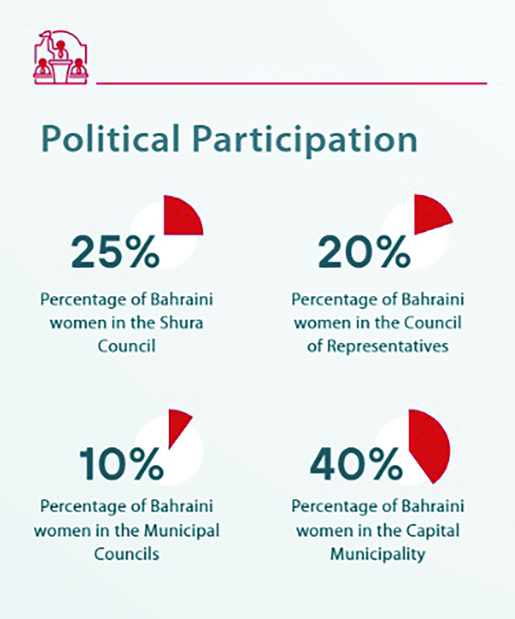
Percentage of political participation by Bahraini women
&uuid=(email))