

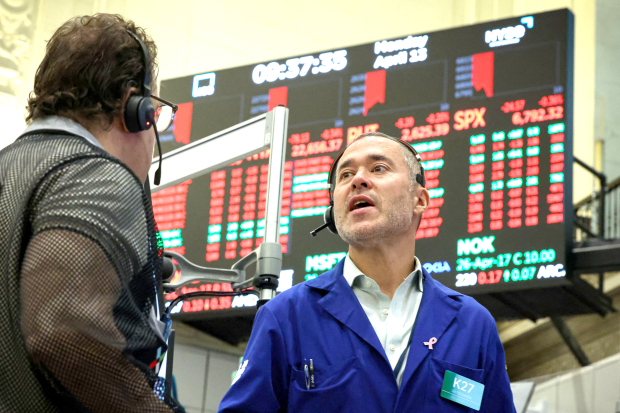
Wall Street stock indexes were mixed and oil jumped back above $100 a barrel yesterday as the US moved to block ships leaving Iran’s ports after peace talks collapsed at the weekend.
A fragile ceasefire hung in the balance as the US put pressure on Tehran, prolonging a choke on Middle East energy exports and sending jitters through equity markets.
The Dow Jones Industrial Average fell 0.54 per cent, to 47,660.03, the S&P 500 fell 0.10pc, to 6,809.90 and the Nasdaq Composite was flat in percentage terms at 22,901.73.
Brent crude futures were up 5.14pc at $100.07 a barrel as traders eyed the Strait of Hormuz, where Donald Trump said the US would start a blockade. US crude rose 4.99pc to $101.39 a barrel.
The pan-European STOXX 600 index fell 0.34pc.
“We expect renewed pressure on risk assets and upward moves in oil early this week,” said Benjamin Jones, global head of research at Invesco.
“There has been a de-escalation in the armed conflict but the scale of the de-escalation and lack of clarity on when trade flows will resume leaves us broadly still in the same place – status quo – from an economic perspective.”
Goldman Sachs beat analyst expectations for quarterly profit, but weaker revenue from its fixed income, currencies and commodities division dragged shares down 4pc and weighed on peers Morgan Stanley and JPMorgan.
US Treasuries traded lower, pushing yields on benchmark 10-year notes up 0.2 basis points to 4.319pc, from 4.317pc late on Friday.
“The market is now largely back to conditions before the ceasefire, except now the US will block the remaining up to (2 million barrels) Iranian-linked flows through the Strait of Hormuz as well,” said MST Marquee analyst Saul Kavonic.
“The key remaining question is if the US renews strikes on Iran, raising the risk of strikes on energy infrastructure across the region which could have a further lasting impact beyond the duration of the war.”
The steep rise in energy prices has prompted investors to prepare for the possibility that central banks including the European Central Bank and Bank of England will lean towards raising rates. Minutes from a meeting of the Federal Reserve last month showed a growing number of policymakers felt rate hikes might be needed.
All of this is a sharp reversal from expectations prior to the war for rate cuts or a prolonged pause.
Last week’s US inflation data showed consumer prices rose by the most in nearly four years in March, driven by a record surge gasoline costs. Money markets show traders see less than a 20pc chance of the Federal Reserve cutting rates this year.
Meanwhile, London’s stock indexes fell after the US moved to blockade Iranian shipping following the collapse of the weekend peace talks.
The blue-chip FTSE 100 index fell 0.4pc to 10,558.38 points, while the midcap FTSE 250 slipped 0.8pc.
London markets were swept up in a risk-off stance globally as failed US-Iran talks pushed up oil prices to more than $100 a barrel again.
The two indexes had logged gains last week after a two-week ceasefire between the US and Iran
Heavyweight banks came under pressure, with HSBC and Barclays leading the declines, down 1.1pc and 1.3pc, respectively.
Energy stocks gained, with Shell and BP rising about 1.8pc each.
Travel and leisure stocks declined as oil prices jumped. Cruise operator Carnival was down 3.9pc, while airlines also inched lower.
EasyJet and Wizz Air fell 4.3pc and 7.3pc, respectively. Bernstein downgraded Wizz to “market-perform” from “outperform”.
A report said finance minister Rachel Reeves would set out her approach to help businesses struggling with higher energy prices later this week, in the wake of the Middle East conflict.
&uuid=(email))