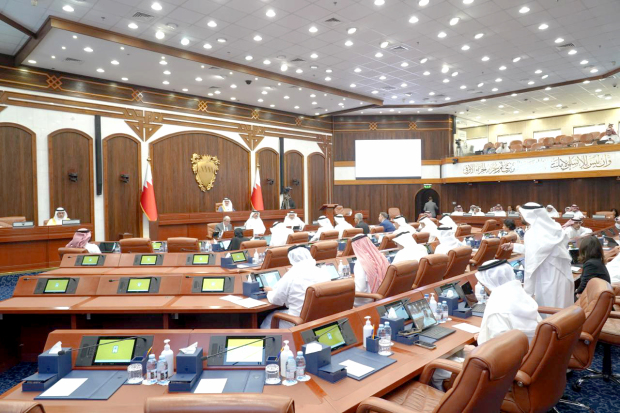
Parliament will debate a landmark government-drafted bill to regulate private educational institutions, with an aim to improve governance and enhance educational quality.
The 36-article draft law replaces the long-standing 1998 law governing private education and training institutions.
It introduces new standards for licensing, management, financial supervision and accountability, as well as updated penalties and incentives to promote excellence and transparency.
The proposed law was referred to Parliament’s services committee, which, after consultations with the Education Ministry and representatives of leading private schools, has recommended its approval, in principle.
Committee chairman MP Mamdooh Al Saleh described the legislation as ‘a long-overdue and forward-looking reform’ that reflects the government’s commitment to ensuring quality and accountability in all educational sectors.
“This law represents a new era in Bahrain’s private education landscape,” Mr Al Saleh said. “It establishes a balanced framework that both protects students and parents and encourages responsible private investment in education.”

Mr Al Saleh
According to the services committee report, the Education Ministry highlighted that the current law, unchanged since 1998, has become outdated and “no longer reflects the scale and complexity of the private education sector,” which now serves nearly half the number of students enrolled in public schools.
The ministry also noted that under the proposed framework, heirs of deceased school owners will be permitted to retain ownership, resolving a long-standing issue under the previous law.
One of the most significant reforms in the proposed legislation is the establishment of strict oversight on school tuition fees. Private schools will be required to obtain ministerial approval for any changes to tuition rates, with a clear appeal mechanism for rejected requests.
The ministry will also monitor curricula to ensure consistency with Bahrain’s values, national culture and religion.
“The law introduces a balanced mechanism to regulate school fees, ensuring they are fair, transparent and proportionate to families’ budgets,” Mr Al Saleh said. “This enhances social justice and keeps education accessible without stifling schools’ financial sustainability.”
The bill authorises the ministry to impose administrative measures, ranging from written warnings to fines of up to BD100,000, temporary suspension, or revocation of licences for serious violations.
It also introduces clearer investigation and appeal procedures, as well as explicit criminal penalties – up to one year in prison and fines of up to BD100,000 – for operating without a licence, submitting fraudulent data, or obtaining licences through deceptive means.
The bill seeks to grant incentives and privileges to high-performing institutions, such as greater flexibility in developing curricula, priority participation in government programmes, or simplified licence renewals.
“Accountability is essential,” Mr Al Saleh said. “This law safeguards educational integrity by ensuring that only qualified, transparent, and law-abiding institutions are allowed to operate.
“If passed, the new law will replace Decree-Law No. (25) of 1998, with all existing private educational institutions required to regularise their status within one year of the law’s enactment,” said Mr Al Saleh.
A draft amendment to the Education Law, which seeks to give parents more flexibility in enrolling their children in the first grade in the same year they turn six, is also up for debate during Parliament’s weekly session on Tuesday.
Currently, the law restricts the enrolment of children who have already turned six at the start of the school year. The new law would allow students who turn six at any time during the same calendar year – up to December 31 – to begin their basic education.
Parliament will also vote on an amendment to the 2014 Traffic Law that would give people chance to halve their fines if they pay the amount within 30 days, instead of the present seven. It was rejected last month by the Shura Council.
MPs will also review a letter from His Royal Highness Prince Salman bin Hamad Al Khalifa, Crown Prince and Prime Minister, on a mutual taxation agreement with the Government of Jersey.
mohammed@gdnmedia.bh